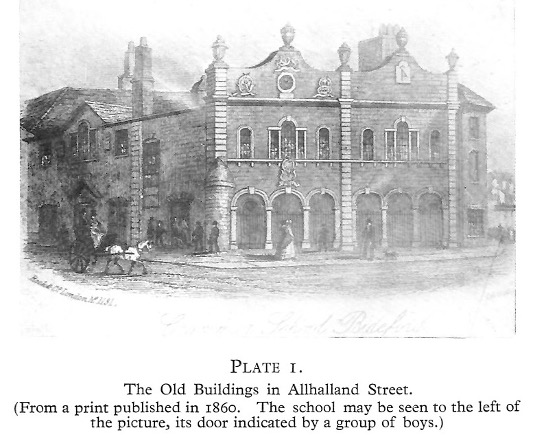
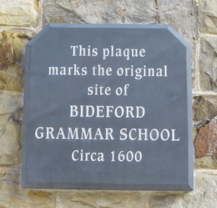
Bideford Grammar School for boys is said to have been founded in the 16th century and was originally sited in Allhalland Street, where it was rebuilt in 1686. This is commemorated today by a plaque on the Allhalland Street wall of the Council offices.
In 1873 the school moved to Northdown Road where it was enlarged in 1908 and recognised as a grant-earning secondary school by the Board of Education.
Since 1929 the school has been maintained by Devon County Council which erected new buildings in Abbotsham Road buildings in 1934-5, and paid fees for selected girls at Edgehill College and Stella Maris Covent school.
This continued until July 1972 when Edgehill was unable to provide sufficient places, and so it was decided that in the following September, there should be a mixed intake of 24 girls to the Grammar School, as the first step towards complete co-education in a County School.
Considerable new building was necessary to achieve the proposals for a comprehensive school (i.e. non selective) and this took place on the Grammar School playing fields. The comprehensive system was completed officially in 1975 and changed its name to Bideford College but it had to operate on two sites until final occupation in 1978
In January 2006, the College won its bid to build a new £55 million school with capacity for over 1,700 pupils. Construction began in 2008 and the first phase was completed in 2010, when all the original 1935 buildings on the site were demolished. The second phase of the building (the outdoor sport pitches) was completed in July 2011.
Historical notes
The Devon CC book ‘Historical Notes on Devon Schools’ describes the BGS thus:
“The Grammar School is thought to have been founded in the 16th century but there is apparently no document evidence to support this. There is a tradition that Sir Richard Grenville who owned the land in this vicinity, and who may well have given the site to the Feoffees, was the founder.
In 1607, according to Ascott’s ‘Random Notes on Old Bideford’, the Bridge Feoffees built a hall for their purposes, incorporating premises for a Grammar School, in the northeast corner between Allhalland St and Bridge St.
The building was of two storeys with a large cellar below, but how precisely the two upper floors were divided between the two main uses is not clear. Muriel Goaman (Bideford in Old Picture Postcards) refers to stairs in Allhalland St leading up to the schoolroom, which suggests the school on the first floor, but in her other publication (Old Bideford District) she quotes the deed of 1617 by which Richard Dunnying rented a bakehouse “with the great seller under the School House”, which suggests the school was on the ground floor. When the Endowed Schools Commissioners reported in 1868 the cellar was used by a cooper.
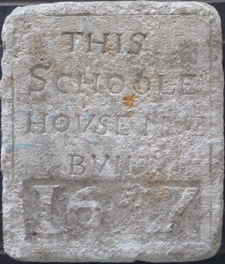
According to a stone tablet removed from the wall of the Allhalland building and preserved at the present school, the school was rebuilt in 1657.
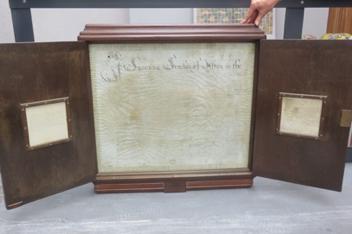
Also preserved is a tablet (see below) commemorating another rebuilding, in 1686, by order of the Mayor and Corporation of Bideford.
In Magna Britannia, published in 1822, Lysons suggests that:
“the Grammar School was supported, probably by the Corporation, by whom 10 boys were then appointed to be taught free.
From the Charity Commissioner’s reports of 1823, it appears that a house in Bridgeland St was purchased in 1817 for occupation by the Master, and that later a private room for the Master was added, which suggests that the house was also used as a boarding house in the period between acquisition of the premises and the provision of the new school in 1878.
The original Grammar School building was an unusual piece of architecture, having on its frontage with Bridge St, an arcade consisting of six arches with the pillars supporting the front of the upper floor.
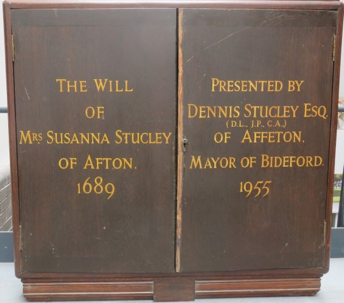
In 1689 the school received an endowment from Mrs Susannah Stucley who left £200 in her will for the maintenance of the school, provided the town could match this sum with another £400, which it did.
In the ‘Book of Bideford’ (2005) there is a chapter called, appropriately, ‘Good Learning’, which puts Bideford’s schools in the historical context of the nation as a whole:
“Before the Reformation, education had been the province of the church; thereafter the main responsibility for ‘good learning’ devolved upon the Corporation and the Bridge Trust, until the arrival of state education.
The old building [in Allhalland St] was still in use in the 1820s.
The school moved for a time to Bridgeland St, where the trustees had bought a house for the master, and in 1851 21 boarders aged from 9 to 17 from places as far away as India and Jamaica, lived there.
In the 17th century, teachers had to be licensed by the Bishop (except during the Commonwealth when Bideford nonconformists, having rebuilt the school in 1657, appointed their own headmasters). After the Restoration two continued to teach, to the great annoyance of the licensed master who complained ‘I can use noe necessary discipline in my schole but presently they can run mee to one of them’.
Parental (or pupil) choice thus began early in Bideford, where it was now also possible to achieve literacy without Latin. As early as 1625 an application for a licence had been made on behalf of William Parsons, who could not only teach writing, but was:
“… skillful in the Art of Arithmetricke, very fitt and necessary to teach in this our towne of Bydeford being a towne of Navigation where such a one is to be imployed for the instructing and teaching the Children and printices of the inhabitance of our towne” …
Arithmetic and navigation continued to be important subjects in Bideford and in the 18th century, George Donn, who kept a private school, and his sons Abraham and Benjamin, who taught there, were outstanding mathematicians. Benjamin’s works included a volume of mathematical essays and a remarkable large-scale map of Devon, printed in 1765 from his own survey. There were many other private schools in Bideford by this time, both for boys and girls. Peter Glubb paid up to £3 a year for his daughter’s schooling, and as much again for their dancing lessons.
Lower down the social scale there were ’poor women to teach Little Children to Read’ for a penny or two, and after 1761 even paupers’ children were taught arithmetic, navigation, reading and writing in a ‘Commercial’ school founded by the Bridge Trust for ‘ten children either boys or girls, six of which to be taken from the workhouse and four from the poorer families of Bideford.’
This school continued until 1878, and in the 19th century, there was also a school within the workhouse itself.
After 1800 schools for the poor were built all over the country, both by the Church of England’s National Society founded by Andrew Bell, and Joseph Lancaster’s rival British and Foreign Schools Society which, although non-denominational, mainly attracted nonconformists. Bideford’s National School, known as Bell’s School, was built in Old Town in 1823 and was supported by donations, church collections, balls and small fees. This provided 200 places for both boys and girls.
The Bridge Trust, showing no sectarianism, contributed to both the National School and the British School, which was opened in Higher Gunstone in 1836 for another 200 pupils. Both operated on the monitoring system, where the teacher taught a group of older children, who then instructed the younger ones. The system, although ‘one of mass production in education’, was better than nothing. Rivalry between the two societies continued, but the state, which was making grants to both, gradually began to regulate elementary education.
Parliament ordered a survey of all schools in England in the 1830s and published the results in 1835.
The Bideford entry is intriguing and shows, by the number of schools available, just how important Bidefordians saw education.
The Education Act of 1870 decreed that local school boards should be set up, with elected members and funding from the rates which was to provide school places for all children between 5 and 12 years.
In 1868 a new headmaster [J L Kitchen], finding the building ‘insanitary and incommodious’, moved to Edgehill House in Northdown Rd and changed the school’s name to Bideford College. The move was unsuccessful until 1879, when a new head [R F Heath] was appointed and new buildings erected in Northdown Rd to house the 32 pupils then enrolled. Here the school stayed for the next 49 years.
The new premises in 1878 were sited on land purchased in 1877 on the north side of North Down Rd, 200 yards from its junction with North Rd. The old schoolroom, together with the Bridge Trustees Hall, was demolished shortly afterwards and the present Bridge Buildings erected. The new school consisted of a house for the Master, a large schoolroom, and a small classroom. The Master’s house, built with 5 bedrooms, could accommodate some boarders.
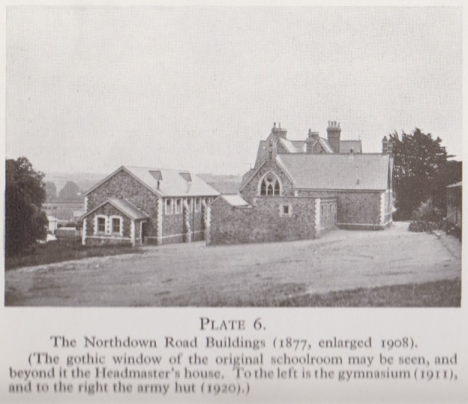
Two classrooms were added in 1908 (when it was recognised as a grant earning school by the Board of Education) and a gymnasium in 1911, the County Authority making a grant of half the cost of the latter. The school was included in Devon County Council’s first grant list of 1904 but was not taken over by the Council as a Maintained school until 1929.
In 1914 the Governors put forward proposals for matching the accommodation to the numbers on the roll and plans were prepared for 120 boys. Evidently the scheme was not acceptable at the time and the best that could be contrived was the provision of an ex-army hut, 75 x 15ft, divided into 3 classrooms, in 1919.
In 1925 a proposal was put forward by the Governors that in view of the many defects in the building and the unsuitability of the site, a new site of 6 acres on the west side of the town, be purchased for immediate use as playing fields and later for a site for a new school. It was some years before the new school was built by the Education Authority on Abbotsham Rd, during 1934-1935. The school was for 240 boys and consisted of classrooms, laboratories, hall, lecture room, library, gymnasium and art and handicraft rooms.
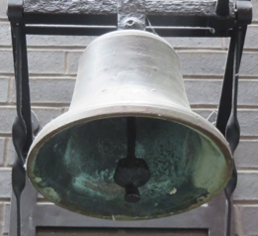
School bell (was this in Allhalland St?)
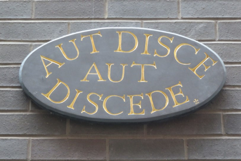
The school motto – either learn or depart.
Other historical references
Deeds from 1667-8 refer to a:
‘messuage or tenement with appurtenances in Bushton, parish West Buckland, sometime the lands and inheritance of Sir George Raleigh of Farnborough, knight, his son and heir, and parcel of the manor of West Buckland’.
This property was first in the possession of the Joce family, and then passed to the Furse family.
In a N Devon Record Centre file there is an undated note from Morris Marples (Head, 1931-7), and author of ‘A history of Bideford Grammar School published in 1937) entitled “A note on the history of the school”:
‘A further discovery bearing on the history of the school has been made, again by Mr William Henry Rogers of Orleigh Court. In the minutes of the Bideford Quarter Sessions for 1686, there is a reference to “William Deare, Clerk, Schoolmaster in Bideford, who made his declaration (of Allegiance and Supremacy) in open court according to Act of Parliament”. The circumstances show that he must have held some official position, almost certainly the mastership of the Grammar School.
The date is particularly interesting, for it is the same as that borne by the large tablet in the Assembly Hall recording the second reconstruction of the School. Here then, in the person of the Rev. William Deare, is the Master who was probably responsible for the curious Latin couplet on this tablet:
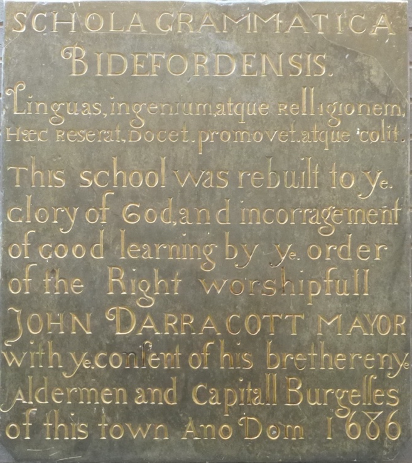
The meaning in Latin is:
“Bideford Grammar School. This loosens the tongue, instructs the intelligence, promotes and fosters religion”
Since the re-endowment of the School by Mrs Susannah Stucley took place only three years later, in 1689, Deare may also have been the last Master of the original School, and it may have been during his term of office that the fortunes of the School reached the low ebb implied by the wording of Mrs Stucley’s will.”
1689 Susannah Stucley left £200 in her will ‘to be laid out in lands for the maintenance of a Grammar School in Bideford’.
9 March 1695/6 there was an agreement to:
‘convey [from] John Furse of Great Torrington, yeoman, to George Strange, Mayor, John Darracott and 14 others. All those messuages, land and tenements called Bushton or in Buston, West Buckland, for 900 years, for £620 and a broad piece of gold, to be paid in instalments of £220 and the piece of gold at the sealing of the conveyance and £400 at the end of 6 months without interest, but in default of the £400 interest is to be paid on it from the end of the 6 month period.’
30 Mar 1695 an agreement was recorded:
‘between 16 gentlemen and merchants of Bideford and Richard Robertes (sic) of Bideford, schoolmaster, appointing Robertes to keep a school in the school house of Bideford for the education of youth in Latin, Greek and Hebrew, from 1 Apr next. He is to teach 6 poor children of Bideford after the expiration of 1 year, and to receive £20 per annum out of the sum collected for the school until it is laid out in an estate, after which he is to receive the yearly benefit of the estate.’
20 March 1696/7 by a:
‘Bond in £1,000. Between 1. John Furse of Great Torrington, yeo. and his sister Anne Furse, and 2. George Strange, merchant of Bideford [and 16 others including John Darracott].’
20 April 1696:
‘John Furse [issued a] receipt for the purchase money of Bushton’.
27 September 1699 there was an:
‘Assignment of Furse’s mortgage to 17 individuals’ – [including John Darracott & George Strange – both Aldermen of Bideford Borough, and eight who were feoffees of Bideford Bridge Trust].
21 April 1742 there was an:
‘Agreement by [the Bridge Trustees] to pay £20 out of the Bridge Stock to Richard White schoolmaster in consideration of the late losses he has sustained by the School estate, endorsed with White’s receipt, 7 June 1742, and receipt from Hercules Welsford for £5 on account of the Bridge for Stock to the ‘Feoffees’, 7 June 1742.’
22 December 1750 there was a:
‘Resignation of Richard White, Clerk, schoolmaster of the Free School, and quit claim to the school and estate called Bushtown, West Buckland, in consideration of £10 and an annuity of £10 to be paid by the corporation and Feoffees of the Long Bridge out of Bridge Stock.’
28 May 1751, a trust was set up:
‘Assignment of term in trust to Dennis Stucley of Bideford and many others. Reciting Susannah Stucley’s bequest of £200 for the maintenance of a grammar school at Bideford provided that £400 in addition were raised by the town, and that £420 had been raised, and the money expended on the purchase of messuages, lands and tenements called Bushtowne or in Bushton, West Buckland, containing 80 acres, for 900 years. And that George Strange, John Darracott [and others] the only surviving grantees in a tripartite indenture of 19 April 1721, bargained and sold to William Strange and John Tallamy of Bideford, merchant, the premises above named to the use of George Strange, John Darracott, Dennis Stucley [et al] for the remainder of a term in trust for the maintenance of a Grammar School.’
17 October 1751:
‘Minute of meeting for election of schoolmaster. Governors present named, voting recorded, Mr Marshall elected by 8 votes against Mr Griffith 7 votes. Signed by 13 of governors present.’
26 October 1751:
Agreement with bond between the trustees of the lands belonging to the Grammar School and Humphrey Marshall of Bideford, clerk, appointing Marshall to be master of the Grammar School. He is to receive the rents and profits of lands purchased for the use of the master. He is to teach Latin and Greek, and to instruct 3 poor boys free. Provisions concerning fees payable by those whose ancestors had contributed towards the endowment of the school.’
4 May 1753:
‘Two parts of agreement, with bond, between the trustees of the lands belonging to the Endowed Grammar School and William Walter of Merton, clerk, appointing Walter master of the school.’
A series of leases were agreed:
‘Leases of the Bushton property, also called Bushtown, from the trustees of the lands belonging to the Bideford Grammar School, 1752, 1772, 1793, 1814, 1829, 1843 and one draft lease 1843.’And a:
‘copy scheme for the apportionment of the Bridge Trust, Bideford, and for the assignment of the educational part thereof to the Governors of Bideford Grammar School, was submitted to the Committee of Council on Education.’
13 May 1803:
‘Agreement, with bond, between the trustees as in EFM 22 and EFM 23, and Thomas Ebrey MA, of Magdalen College, Cambridge, appointing Ebrey master of the school. Payment to master as in EFM 20. He is to teach Latin and Greek, and to teach 3 poor boys free.’ [Note the spelling Ebrey here as distinct from Ebray in later documents]
13 March 1813:
‘Agreement between the trustees as in EFM 22 and EFM 23 and the Reverend William Woodcock BD, late of Hay Brecon but now of Bideford, appointing Woodcock master of the school. Payment to the master as in EFM 20. He is to teach Latin and Greek, and to teach 3 poor boys free. Minimum school hours and maximum vacations are prescribed.’ [This is the first reference to a Reverend, yet on the board in Bideford College, 15 out of the first 16 headmasters are listed as Rev.]
4 December 1815:
‘Agreement between the trustees of messuages (sic), lands and tenements belonging to the endowed school of Bideford and Francis Harriman Hutton of Launceston, Cornwall, gent., appointing Hutton master of the school. He is to receive the profits of the school estate called Bushtowne and the dividends from stock until it is laid out in the purchase of a house for the master. He is to teach Latin and Greek according to the Eaton plan and the elements of geography, astronomy and general history, and to teach 3 poor boys free. Minimum school hours and maximum vacations are prescribed.’
30 August 1817:
‘Lease of dwelling house and garden in Bridgeland Street lately purchased by the trustees of the Endowed Grammar School, from the same trustees to Francis Harriman Hutton, schoolmaster of the same school, for 80 years if he so long continues master of the school.’
1 November 1826:
‘Agreement between the trustees as in EFM 28 and the Reverend Henry Alford, appointing Alford master of the School. He is to receive the rents of the school estate called Bushtowne and to have possession of a dwelling house. He is to teach subjects as in EFM 28, and to teach 3 poor boys free. Minimum school hours and maximum vacations and maximum fees for day scholars are prescribed.’
1 March 1828:
‘Lease as in EFM 29 to the Reverend Henry Alford, with pencilled alterations for Hugh Fowler.’
1 January 1850:
‘Agreement between the trustees as in EFM 28 and the Reverend Hugh Fowler of Helstone, Cornwall, clerk, appointing Fowler master of the school. He is to receive the rents of the school estate called Bushtowne and the possession of a dwelling house in Bridgeland Street. He is to teach Latin and Greek and all other branches of a classical education, writing, arithmetic and mathematics, and to teach 6 poor boys free in the same manner, writing and arithmetic excepted. Minimum school hours and maximum vacations and maximum fees for day scholars are prescribed. The master is to provide at his own expense an assistant when there are 30 boys, and an additional master for each additional 30 scholars, and to allow public examination of the scholars when the Trustees require.’
30 December 1858:
‘Agreement between the trustees as in EFM 28 and the Reverend Abraham Kerr Thompson of Dudley, Worcester, now of Bideford, clerk, appointing Thompson master of the grammar school. He is to receive £50 a year, less rates and taxes, out of the rents of the school estate called Bushtown unless it is let at less than that sum, and the possession of a dwelling house in Bridgeland Street.’
21 November 1859:
‘Articles of agreement between the trustees [as in EFM 28] and the Reverend Abraham Kerr Thompson of Bideford D.D. headmaster of the Endowed Grammar School, for the instruction of one additional boy free in consideration of Thompson receiving the interest on a gift of £150 lately made to increase the capital of the trust estate upon condition that a boy be taught free.’
c1890s, a table was created showing the appointment of headmasters 1879-1894.
There were 5 headmasters appointed from Thompson’s retirement in 1868 and Fergusson being appointed in 1905.
1902: Letter from headmaster Faulkner with Remarks by the Head Master on the Report of the Inspectors of the school.
‘Teaching: ‘Except in the case of Drawing, the Report is highly favourable. With regard to Drawing, I emphatically deny, in toto, the explanation mentioned by Mr Narraway as supplied by the art teacher “that the boys are unmanageable’. No other master finds or has found the same difficulty. Therefore, the fault cannot be in the boys.’
1905: Letter of application for post as headmaster from James Stuart Fergusson BA.
29 September 1908 the Bideford Gazette recorded the opening of new classrooms and a prize distribution by Sir Thomas Acland, Chairman of the Devon Education Committee:
‘The BGS was started originally in 1689 by Susannah Stucley who by her will left £200 to be laid out in lands for the maintenance of a Grammar School in Bideford, provided the town raised a further sum of £400, which was done, and an additional sum making the total £620, with which a farm called Bushton, in West Buckland, was purchased and retained until about 1820. The income from the estate and certain stock purchased with the sale of timber on the estate, was devoted to the school and to the education of a certain number of scholars free. For a number of years the school had a somewhat chequered career, but it was felt by the townsfolk that it would be a pity to let it go altogether, and the Bridge Trust were accordingly asked to help it, which they have now done for some years. They gave the fields for the building of the present school some years ago, in addition to making a substantial payment towards its support. For some years past the school has been showing signs of increased usefulness, so much so that it has now grown beyond the limits of its accommodation. The Governors being also anxious to have it recognised as a secondary education school found that it would be necessary to carry out the requirements of the Board of Education, and the present extensions are the result. Especial thanks are due to My Hugh Stucley, JP, CA, one of the Governors, and a descendant of the school, for the large amount of trouble he has taken in the matter, for it is largely through his untiring efforts both in interviewing the educational authorities in Whitehall and on the County Council, that the school has received its official recognition as a secondary school and pupil teacher’s centre. The Mayor of Bideford has also given his warmest support, and when the matter came before the Town Council to say whether it would make the rates responsible for a large portion of the cost in order that the scheme might go through, there was no turning back.
The extensions consist of two large classrooms, which will accommodate between 40 and 50 addition boys. Each room is 18 ft by 51ft, together with new lavatories for the boys and masters, and a large lobby and cloakroom. The accommodation of the school will now be increased up to 100 boys and will be in every respect quite up-to-date.
Sir Thomas Acland opened the new wing. ‘
1938: Parents unanimously supported the idea for a school uniform of black flannel double breasted jacket and medium grey flannel trousers. Mr Harle was appointed the careers master.
Post-1934: A school prospectus was issued.
1935: Programme for the opening of new buildings 2nd October 1935 by The Rt Hon Sir Francis Dyke Acland MP, Chairman of the Devon Education Committee. The proceedings commenced by an address by Sir Hugh N G Stucley, Chairman of Governors.
‘Plans for a new BGS were first drawn in August 1931 by Mr Percy Morris, then County Architect. Their execution was, however, delayed by various circumstances until 1934, when Mr H V de Courcy Hague, the present County Architect, adapted the plan to more recent requirements, and building commenced. The contractors were A N Coles of Plymouth. The first sod was cut in August 1934, thus the building is being opened 14 months after its commencement. Provision has been made for 240 boys.
The building contains an Assembly and Dining Hall with a stage equipped for dramatic work; library and reading room; physics and chemistry laboratories with preparation room; workshop for wood and metal work with an electric lathe; geography room especially fitted out for the study of this subject; biology room; art room; gymnasium with changing room; classrooms; medical inspection room; headmaster’s room; staff common room and changing room; kitchen; book and stationery rooms; cloakrooms; washrooms and lavatories. Adjoining are an asphalt playground and a bicycle shed to accommodate 80 machines. The school grounds are about 12 acres in extent, and are in process of being developed. A football and a cricket ground have already been levelled and other work will be undertaken gradually. The games pavilion, erected last year by subscription, to the design of the Borough Surveyor Mr F R Gray, contains a large central room, two changing rooms with shower baths, sprays and lockers, lavatories and a tool shed.’
27th April 1937: Letter from Mr Rowe, Penzance.
“Dear Mr Marples, yesterday I came across a copy of Pigot’s ‘Royal National and Commercial Directory & Topography of the SW of England’, published by Slater of Fleet St in London. It contained the following reference to Bideford Grammar School which I hope will be of interest to you. ‘The free Grammar School here is an ancient foundation; it was rebuilt in 1657 and a new front was added at the expense of the Bridge Trust in 1780’. Best of luck with your new school.”
2nd November 1938: Letter from W H Rogers to Headmaster Langford.
“I have been carefully considering the problem of naming the houses of your school, and do not think that you can do better than to call them Grenville, Stucley, Darracott and Strange. The Grenville family probably had something to do with its foundation; Mrs Susannah Stucley gave its first endowment; John Darracott was interested in its building; and though there is no recorded connection with John Strange, yet one who was four times Mayor of the borough and responsible for endowing it with almshouses must surely have taken a deep interest in the course of education. The early lists of Bridge Feoffees are unfortunately scanty, and few of the names convey much to Bidefordians of the present day; but Strange’s heroic conduct at the time of the plague is known I think to most, and therefore his name seems to me preferable to either Saltern of Andrew, who were actually Feoffees in 1565. I hope the above may assist your choice. Yours truly, Wm Henry Rogers.”
7th November 1938: Letter from W H Rogers to Headmaster Langford.
“Dear Mr Langford, with regard to John Strange, you will find such particulars as are known of him in Watkins’ ‘History of Bideford pp44, 88 and 225’. There is a portrait of him in the so called ‘Kingsley’ room in the Royal Hotel.
Of the Darracott family, nothing much seems to be known but nonetheless they supplied the following Mayors:
1665 John Darracott
1685-6 John Darracott
1690 George Darracott
1694 John Darracott
1703 John Darracott
1711 John Darracott
1721 John Darracott
1730 John Darracott
Several of them were also members of the Bridge Trust. From the fact that Darracott is found as a local place name in Torrington, Welcome and Georgeham, it seems probably that the family was of Devonshire origin, like many of the 17th century Bideford merchants they had probably gone to Ireland with Strongbow and returned to take their share of the prosperity of the Virginia and Newfoundland trade. There is a note on the family in ‘Devon and Cornwall Notes and Queries’, Vol XVI, p87. I believe the family still flourish in America, though their place here knows them no more. Yours truly, Wm Henry Rogers.”
