Deeks, Fred (BGS 1950-55)
I grew up with a bit of a nomadic existence. Born in Essex, evacuated to Buntingford in Hertfordshire and then aged 2 in 1940, embarked in the Duchess of Bedford bound for Montreal and thence Shanghai. In December 1941 we sailed from Shanghai bound for Vancouver and then home to the UK, leaving my father to the vagaries of the Japanese.
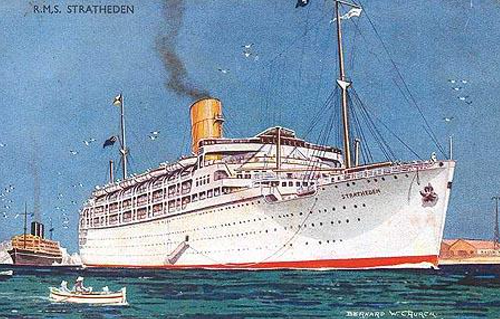
On arrival at Vancouver the High Commissioner advised my mother that it would be impossible for us to return home to the UK and we should find accommodation in Canada for the duration of the war. We settled in Vancouver until August 45 when we returned home to the Uk. We boarded RMS Stratheden which was trooping in Montreal for a voyage to Liverpool. The war in the Far East finished while we were at sea and we returned to a war-torn UK. Having had a protected war, the sights and smells of a blitzed London were a shock and our house in Woodford, although unscathed, had experienced a land mine close by. As a youngster of seven I had a far bit of sea-time already.
My father returned from Shanghai after a particularly nasty Japanese internment camp in a fairly poor condition. Following a spell in Guys hospital he sailed for Shanghai in mid-summer ‘46 to start work again. His health deteriorated and in 1947 he returned to the Uk and retirement.
Mum and dad had decided that they would retire on the coast somewhere and preferably Devon, as they had had some pleasant holidays here in the 30’s when on leave from China. They eventually chose Westward Ho! and we moved into a bungalow in Venton Drive next to the Pebbleridge Hotel. I attended Northam primary School and passed the 11 plus surprisingly, so I joined the School in September 1950. I notice from a poem I wrote that I was in Form 1b, so obviously not the brightest. I enjoyed School albeit I am not sure School enjoyed me. I was in Stucley house and never excelled in any sport so do not appear on any of the boards. I have 8 grandsons all of whom have turned out to be good rugby and cricket players, so sport was clearly not my genes!
I managed to get weekend and holiday work on Fred Wilkey’s farm in Westward Ho! I started off delivering milk and eventually filling milk bottles, then milking cows and helping at lambing time. Although winter was hard, breaking out mangles from a frozen clump to feed the sheep on a Saturday afternoon, milking in the parlour made up for it. I really enjoyed the life and decided I would like to be a farmer. At about this time we were asked if we would like to join the ACF at school. My father had fought through the first world war from 1914 -18 in the infantry. His experiences put me off joining the army with his tales of the trenches, poor food and not much fun. I decided that the sea cadets offered a better teenage experience, so I joined TS Revenge which was moored on Bideford Quay.
Meanwhile at school my education carried on and I now have the greatest respect and admiration for all those teachers who tried desperately to improve me. I still remember Mr Treganza’s stories about schooling in Mousehole, and walking barefoot to get there. I also have memories of the weapons of mass destruction wielded by Messrs Parry, Bartlett and Witter. I was caned for cheeking Mr Courtney and to this day I sincerely regret that I caused him some hurt.
However, time went on and I thought a career in farming would start with a course at Seal-Hayne College of Agriculture and a career in farming. Unfortunately, I had not thought through the process very well and my parents were very much against it, as there was no money to buy a farm and livestock let alone the equipment necessary. When I had my career discussion with Mr Harle, he was at pains to express the many issues and what a waste of a grammar school education to be a farm labourer.
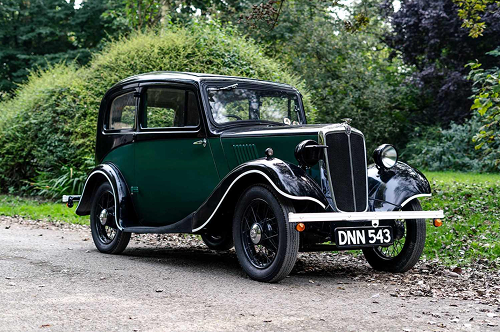
There was a period just after when I rebelled against my parents but eventually common sense prevailed. I was enjoying the sea cadets and during school holidays, I started attending courses onboard ships at Portsmouth for a week, learning various aspects of seamanship. I also enjoyed tinkering with bits of machinery including helping Mr Witter with his Morris 8. The car was mechanically sound but the rest of it left much to be desired. A friend had a garage in Westward Ho! which he used, and I would help him with top overhauls, plugs, points and the odd suspension issue.
The Commanding officer of the Sea Cadets was Lt Rowe. He was the manager of the garage on the Quay and persuaded me to look at a career as an artificer apprentice in the RN. The summer holiday of 1949 included a three-week course at the Internal Combustion Engine (ICE) School held Chatham Dockyard. I think that was the final selling point of a naval career. There were a range of engines from small outboards to motor launch, submarine main engines and 750 Kw generators. Each type of engine had something wrong with it, which we had to find and correct. I was sold on the RN.
This would mean leaving School in the 5th form and undertaking a four-year apprenticeship in an engineering discipline with an ONC on completion. My parents thought a Merchant Navy career may be better but having experienced the RN, I decided to take the Artificer route. I could have taken the Dockyard entrance exam which offered a similar route, but a career in HM dockyard instead. Joe Peglar took this exam but our paths never crossed. I took the Artificer entry exam and with some intensive help from Mr Bartlett and Mr Reed learning applied maths, I passed well up the board. Those of you who remember Mr Green from Woodwork and Art, will recall the encouragement he gave in learning the basics of hand tools, the lathe and technical drawing, all of which stood me in good stead during my early career.
I joined HMS Fisgard, the Artificer training Establishment, in January 1955 and spent 18 months there learning various craft trades and continued the technical subjects of physics, maths, electrics, workshop theory and English. Sport played a large part with rugby, football and cricket available, as well several indoor games. I learnt to sail in whalers, cutters and our Windfall yacht Planet. This was a yacht taken from the Germans as reparations and was beautiful. Sailing was my go-to sport and I continued to sail for many years.
After 18 months at Part 1 training, I opted to take a Marine Engineering course which was a further 42 months of trade training and academic study to ONC level. This took place in Rosyth Scotland, which was the other end of the world from Westward Ho! The half term weekend of four days was insufficient to make it home, so I spent it sailing or rock climbing. My four years apprenticeship could occupy another story, but it was finally over in December 1958 and so to sea.
My first ship was HMS Starling, a Black Swan Class Sloop, famous for sinking 21 U-Boats under Captain Freddie Walker. She was a Steam Turbine vessel and I was to get the first of my operational tickets on her. The highlight of my year onboard was a trip to the Norwegian Fjords and then the German U-boat base at Kiel. One of our engineers had been sunk on the Royal Oak in Scapa Flow. Human nature being what it is, he was feted by the German sailors and we literally poured him back onboard. It’s a shame the politicians of this world cannot get on with each other.
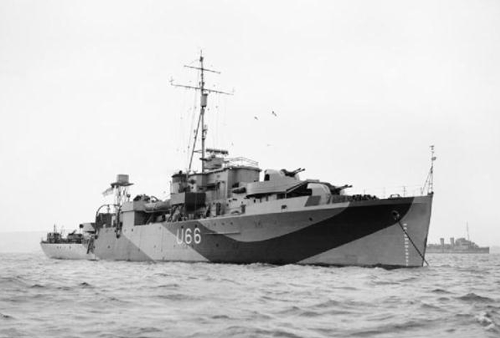
HMS Starling, the most successful anti-submarine warfare vessel of the Royal Navy, being credited with the destruction of fourteen U-boats.
In order for me to get promotion I need to obtain my Boiler and Steam Unit Watchkeeping Tickets. As well as the trade requirements to maintain ship’s equipment, we were required to operate the machinery. HMS Starling had enabled me to obtain the Auxiliary machinery ticket, but not the more important Boiler and main machinery one. I could operate everything from refrigeration machinery, hydraulics, compressors, generators and distillers safely, but would need to sail on a more modern vessel for promotion.
My next ship was HMS Saintes, a Battle Class destroyer with Superheated steam boilers and geared Turbines of 55,000 shp. We commissioned her in 1960 at Devonport and deployed to both Home waters and the Mediterranean. Highlights of the commission were the first Cod war off Iceland, where we spent 8 weeks trying to stop the Icelandic vessels arresting our trawlers for fishing inside their widened territorial waters. The trawlers were mostly pre-war I think so were often called out to repair them when broken down. I am convinced the owners knew that we would support them and keep them afloat! Having experienced their life, I never objected to paying over the odds for a piece of fish. The highlight of the Med deployment was a fortnight in Gibraltar when my wife was able to visit for a few days; it was our first holiday together as we couldn’t afford a honeymoon.
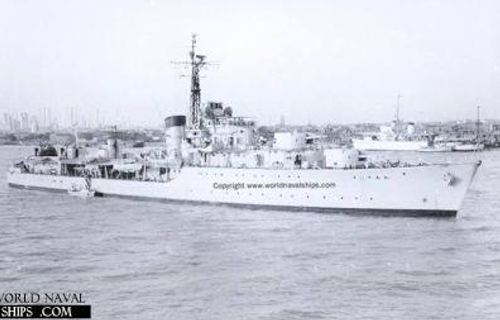
HMS Saintes was a 1942 Battle-class fleet destroyer of the Royal Navy. She and 15 sister ships being ordered under the 1942 defence estimates. The ship was named after the Battle of the Saintes, a Royal Navy victory over a French fleet intending to invade Jamaica in 1782.
Two other engagements are worth mentioning. Apparently, an MP visited Skyros, an Island off Greece where Rupert Brooke is buried and his grave had deteriorated. The Admiralty was instructed to send a ship and restore the grave. We arrived to find the grave in need of much TLC. As I was a welder, we made some new pieces for the railings, welded it all up, repainted them and cleaned off the marble surround. Fancying a swim, we went to the beach only to be met with swarms of flies and beat a hasty retreat. We were due home in mid 1961 and undergoing maintenance in Malta, Iraq threatened to invade Kuwait and the UK rushed to support Kuwait. We had Paratroopers, Tanks and RAF in Bahrain. The aircraft carrier Victorious deployed from Singapore, and three Destroyers from Malta to provide shore bombardment if needed. We steamed at 30kts with a refuelling stop at Aden, arriving just in time to see it all over. During the 24 months I was onboard, I obtained my Boiler Watchkeeping and unit tickets. The latter allowed me to watch-keep on machinery up to 50,000 shp and gain further promotion. I would need a further charge ticket to have the authority to take charge of a vessel up to a 50,000 shp engineering plant.
I was very keen to spend my career on ICE powered vessels which meant in most cases, being on small ships. My next two ships were minesweepers. The first one, HMS Kirkliston, was Deltic powered (Railway buffs will know about these) and was fitted with activated rudders as a test bed for the 1970 minesweeper class. The second was HMS Laleston powered with a Mirrlees Diesel.
My next commission was on a landing Ship Tank HMS Redoubt. Built in1944 on the Manchester ship canal in preparation for the war in the FE. She never got there but my year onboard was spent in the Persian Gulf. I had the opportunity to take some junior ratings to Persopolis and Darius Tomb. We flew from Bushire to Shiraz and were made very welcome by everybody despite language difficulties. Why is it everywhere you go somebody can speak English?
My next two years were spent in Libya training young Libyan sailors in the rudiments of marine engineering with two Ham class minesweepers given by the RN. The Libyan government bought a corvette from Vosper Thornycroft in Portsmouth and I spent quite a few months standing by, whilst my wife and children were in Tripoli.
My last ship was HMS Lynx a Type 41 Frigate powered by 8 Admiralty designed diesels and armed as an Anti-aircraft early warning radar vessel. It was a fairly conventional two years with deployments to the north Atlantic, Mediterranean, Far East. For me, the highlight was a three-month voyage around Australia visiting Mackay, Sydney, Melbourne, Adelaide, Port Lincoln and Albany, before our last trip, an exercise with SEATO navies and a visit to Bangkok.
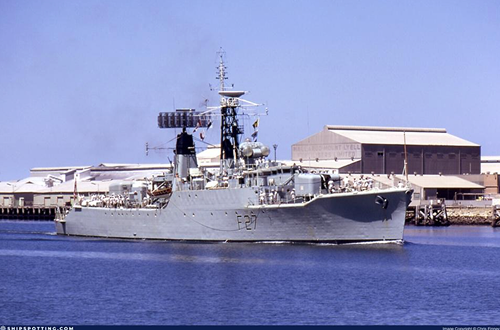
The Leopard-class, or Type 41, frigates were designed for anti-aircraft protection for convoys.
As my wife had had enough, it was time to step ashore and find another career but one with ships in mind.
After 16 years’ service I joined an Engineering consultancy working for shipping companies, Esso, BP and Cunard, planning repair work whilst on voyage.
I joined Vosper Thornycroft (VT) shipbuilding as an Engineer Manager working on Libyan, RN & Brazilian Frigates/destroyers and as Project Manager on the first all-GRP minesweeper. After 20 years in shipbuilding, I moved to the logistics area responsible for worldwide support to Navies that VT had built ships for, and business development for the changing face of ship procurement and defence contracting.
My final job was as a Director of Fleet Support Ltd, a VT joint venture company set up to manage Portsmouth Naval Dockyard.
In retirement I have a smallholding with cattle and sheep.
