This summary of school activities and personalities has arisen from browsing 64 years of the school magazine from 1900 to 1971 (when the school effectively joined with the County Secondary School as a comprehensive).
The earliest extant copy is Volume 1, Number 2, for mid-term Christmas 1900 and this series appears to have ceased by 1902. It was another 30 years before the idea was revived.
From 1900 to 1951, the format seems to have been one issue for each term except for the WW2 years. From 1952 on, there was only one issue per school year (i.e. the autumn term of the previous year and the following spring and summer terms for the dated year), up to 1971. The total number of magazines scanned was 64, making a total page count of 2,200, which represents an invaluable archive of very detailed information for future genealogists and historians.
I have skimmed each page of this archive and typed up what seemed to be of archival value i.e. the novel, important, amusing or quirky items that simply piqued his interest, resulting in a 79 page document with 32,000 words.
Inevitably, not all these magazines have survived; judging from the Volume and Issue numbers, 16 are missing.
In 1986 the Old Boys Association revived the publication and 34 of these post-school editions to 2019 have been scanned, making a total of 98.
1900-1902
The early editions of the Bidefordian were only published from 1900 to 1902, with the school colours in vertical bands on the cover, and it contained 2-3 pages of school notes and a number of stories and articles not written by members of the school. The earliest extant copy is No 2 from Christmas term 1900 This was right in the middle of the Boer War, which doubtless explains why there is an article on fellow Devonian Sir Redvers Buller, who landed in Cape Town as head of the British army in S Africa on
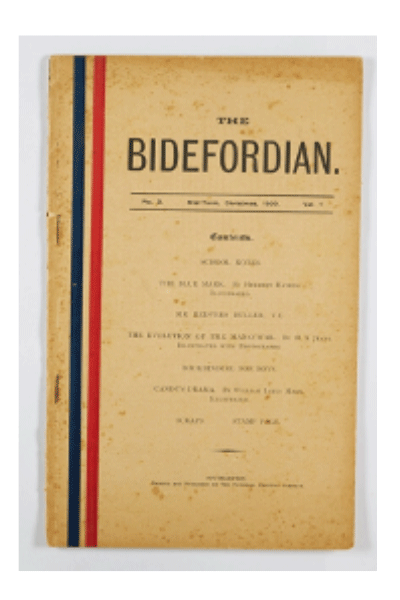
31 Oct 1899.
Vol 1 comes to an end with No 6, which implies that Nos 4 and 6 had been produced, and therefore 3 per year, establishing the long-term sequence of one edition per term.
As John Faulkner was Head from 1894 to 1904, one must presume that he was the founding father of the Bidefordian.
The ‘School Notes’ section in 1900 states that Bidefordian No 1 had a “ready sale” and enquiries had come from the Old Boys, which “seem to promise an increased circulation” and that “the interest of Old Boys is gratifying and full of promise”.

Members may be surprised to learn that the winter sport was hockey and a match had been arranged against the Old Boys on Nov 5th – with a bonfire afterwards, for which “a pile of timber is already being collected and abundance has been promised by several farmers and others”. Surprisingly, there is little other school news; instead, two short stories, articles on the evolution of the maritime Man-o-War, Bookbinding for Boys, and guidance on stamp collecting. The Editor is not named.
All these early editions were printed by the Pictorial Printing and Publishing Company in Southampton, and one imagines that this would have represented a considerable cost, perhaps unsustainable after a couple of years.
The Feb 1901 edition reported on the prize distribution which took place in the Town Hall at Christmas, when the Rector reminded the boys that they “should be preparing themselves as Bidefordians to become worthy citizens of the greatest empire the history of the world has known”. Sentiments I feel sure that Drog would have supported, laced with a heavy religious overtone as well of course. There were prizes for ‘Holy Scriptures’, Languages, English, Mathematics, Commercial Subjects, Use of Tools, Science, Athletics, Reading, General Progress, and Conduct.
By the summer term 1902, the Editor was pleased to report that the Boer War had ended and the Union Jack was hoisted on the morning when peace was proclaimed, and Headmaster Faulkner exclaimed “May it never be lowered except by the hand of a true Briton”. A new Education Bill was expected to give assistance to Grammar Schools and four Inspectors had reviewed the school, a Mr Paddon had been appointed to instruct on Woodwork and a County Staff Instructor had provided instruction on Business Methods, including arranging business correspondence, methods and copying of letters and drafting of cheques.
In the final version of this innovative series, in Dec 1902, the Inspectors’ had rated the school amongst the best in the county. But the real purpose of the inspection was to classify schools in view of the changes which were contemplated under the Education Bill. A considerable increase in the number of boys joining the school was therefore anticipated.
The summer’s cricket matches were reported, including home and away matches against Barnstaple GS, and that the hockey season was underway. As before, the majority of the magazine consisted of short stories, although with a ‘Hints for cyclists’ page at the end.


1932
There were no more editions for the next 30 years because soon after Morris Marples became Head in September 1931, he issued an appeal “to revive our School Magazine, the Bidefordian, last published about 30 years ago, and to put it on a firm basis”; he also urged Old Boys to become subscribers. He intended it to become a “permanent record of current school history” including school and Old Boy news, literary compositions by past and present boys, accounts of matches, photographs of teams, and reports of all school functions such as Prize Day, the Old Boys Dinner, the Concert etc. The price would be 6 pence.

Unsurprisingly, the numbering began again at Vol 1 – although sadly the earliest extant version from this era is No 2, in the Spring of 1932, and it opened with no less than 10 sponsoring organisations, all of which were national, with no local businesses at all. At the very least to get such a range of sponsors but have entailed a great deal of correspondence by Marples. But at least he spared himself the editing duties as the first Editor was Senior Prefect B H Cudmore. An interesting mention was made to a recent donation of a gift to the school from Mr H R Bazeley, President of the OBA, which consisted of a large silver medal, originally awarded in about 1851 as a good conduct prize to the late Rev. F L Bazeley MA, when he was a pupil at the school. On one side was the Bideford arms with the legend ‘Bidefordensis Schola Grammatica’, and on the other side the arms of the Headmaster of that period Dr Fowler.
Another item noted that the school printing press “has been very active this term” and even that “colour printing is to be attempted next”. And it was anticipated that it was possible that the Bidefordian will itself be printed at the school. Ambitions unlimited indeed.
Both rugby and football had become established at the school, with over half the school “now playing Rugger”, and there were photographs of both the first teams.
The 5th annual dinner of the OBA took place on 2 Dec 1931 – hence the first must have been held in 1927 in case anyone had ever wondered about that – with some amusing writing; “the first part of the evening was occupied in mastication and conversation, and the speakers are to be congratulated upon their happy combination of oratory with brevity”. Perhaps future speakers should be reminded of that ancient discipline before the next one!
It was also interesting to note from the various speeches that there were in fact only 71 members of the OBA at that time, although 225 had contributed to a presentation to a retiring present to past Head James Fergusson the previous year.
The Houses were still Saxons, Normans, Romans and Britons and while, as noted earlier, the Editor was the Senior Prefect, the Head Boy was a separate role. There was clearly no local business to print the magazine which was done by the ‘College Magazine Service Production’ in 60 Worship St, Finsbury Square, London.

The design of the summer edition of 1932 had a subtly altered design, the work of Mrs Marples. This design remained constant through to 1961 at the end of Mr Tregenza’s long reign as Editor.
Other changes in the school included the introduction of a Prefects’ cap with a red band around it, Honours ‘Caps’ for games with the customary tassel, an exhibition of Arts, Crafts, Printing and Geographical work, rifle practice, daily meteorological observations, a visit to the Bideford Electricity Works, visits to Plymouth and the Devonport Dockyard and the Bideford Trades Exhibition, Careers advice with articles in the magazine, a school orchestra and summer swimming lessons in the dreaded cold water of the Westward Ho Patio Baths, for which it was hoped to organise a swimming competition with Barnstaple GS at the end of term.
Reference was also made to one of the school’s antiquities, ‘the old bell now in the Borough Museum which once summoned Grammarians of a far distant day to duty in the Allhalland Street school’. I had long wished to identify how far back that bell had been part of the school!
In the Spring magazine there had been 15 advertisers from nationwide firms, with none locally, while in the Summer edition, the number of sponsors’ adverts had increased greatly; there were 15 from London and elsewhere but now with 8 from Bideford, including Boyles the school uniform suppliers which Old Boys will remember. No wonder Marples could afford to get it printed in London.
1933
In 1933 only a single magazine appears to have been produced, Vol 2 No 1 in the summer, because the next one (Vol 2 No 2) was the Spring (Lent) edition in 1934 and it was now printed by a company in Cheapside, London. But at least it now had page numbers! The school’s ambitions were unrestricted it seems; a summer cruise for 20 boys to Scandinavia was planned on the ss Neuralia and a play called ‘A night at an Inn’ – no doubt for the winter months. In cricket the Editor reported on each team member’s performance in quite tabloid terms: “rather given to hitting wildly”, “another disappointment”, “a reliable batsman but still rather cramped”, and to my amazement there was a match of the 1st XI against the Staff, which were “ assisted by Mrs Marples, Miss Wheeler and Gerald and Michael Walker”! Were the ladies opening the batting for the staff team perhaps?
The planned annual swimming event with Barnstaple GS had taken place in July, at the Patio Baths, but “Barnstaple had proved overwhelmingly superior, winning by 69 points to 9”, principally it seems because the school team was on average two years younger than Barnstaple.
The ‘Annual School Journey’ proved very popular with 130 boys assembled on the quay for double decker buses to Ilfracombe, and from there on the Campbell Line steamer ‘Glen Avon’ to Cardiff, where they had a packed day visiting the Municipal Buildings, a lecture and tour of the Museum, the Castle with its Roman origins and Norman Keep, followed by a visit to view the production of the ‘Western Mail’ newspaper, then the BBC studios and finally to the café in Roath Park for tea with the Deputy Lord Mayor. To round off the hot day, the cool voyage to Ilfracombe revived spirits, but on the return journey to Bideford the “leading bus became overheated and the hot exhaust pipe caused the floorboards to ignite”!The trip was organised, of course, by the geography Master, Welshman Gerald Rhys Phillips. This was the 5th such annual event so clearly these had begun in 1928 during James Fergusson’s tenure.
1934
The edition in the Spring of 1934 used the biblical format, Lent, for the first time (it lasted until only 1939) but it marked the end of only the 3rd rugger season, which had begun in 1931. The printer changed yet again, in favour of the Kemp Hall Press in Oxford.
Improvements in the 1st XV over those seasons was marked by results such as losing to Ilfracombe 63-0 in 1931, but winning 16-11 away from home this year. The Colts XV’s progress was even more marked, winning all their matches to date, culminating in a 63-0 win at West Buckland, with an overall score of 233 points with only 11 against.
It was captained by a remarkable athlete, G J Norman, who many Old Boys will remember as their English teacher (from 1947 to 1956). In this issue, he was congratulated for his other rugby successes: playing in the N Devon v S Devon match at Bideford on Dec 9th 1931, then Devon v Cornwall at Plymouth on Jan 13th when he not only captained the side but also scored a try, the W of England v the East at Coventry on Feb 3rd, England v The Rest at Bath on Feb 23rd, and culminating in being picked as reserve for England v Wales at Cardiff on Mar 17th. Greg Norman played as a forward for the 1st XV as well as the Colts, remarkable, and in this magazine’s review of the players, he was described as “small but strong, and exceptionally quick off the mark, a great opportunist who also works hard”. Truly an illustrious sporting history.
The third Annual School Concert was held in the gym on two days, which had involved almost the whole school in its preparation; E A Slade in particular “drew roars of laughter by his rendering of Falstaff”. Slade was at the school from 1926 to 1934 and clearly a multi-talented individual: Prefect, Higher School Certificate, Hamlyn Scholarship, member of both 1st XV and 1st XI, Honours Caps, Rugby Captain and Vice-Captain of Cricket, Roman House Captain, member of the Dramatic Society and finally, a member of the Choir.
In Feb 1934 a series of six lectures to the Upper School was inaugurated on topics ranging from ‘The aboriginal peoples of N America’ to ‘Banking as a profession’, which took place on Friday afternoons.
The summer edition in 1934 was edited by R A H Hunkin, after the previous Editor, the curiously named R A Yeo-Jenn, left at the end of term to take up a teaching post in a preparatory school in Ewell, Surrey. Ron Hunkin was a Prefect and House rugby captain, became a teacher, lived to the ripe old age of 94, researched the Hunkin genealogy back to 1066 and was a cousin of the present (2020) Chairman of the OBA!
The school visit was to Cheddar Caves, Wookey Hole and the ancient city of Wells; it had been the intention to visit Glastonbury Abbey was well, but “so much time was lost on the journey via Barnstaple, South Molton, Bampton, Taunton and Axbridge, that this was not possible, and indeed the party did not return until after midnight”!
The swimming contest was a three-cornered contest with Shebbear College and Barnstaple GS, although the Bidefordians were clearly not blessed with water wings.
The 21st Annual Sports Day took place in May, as is the custom, which places the first one in 1913 (assuming the war years did not affect the sequence) and one G J Norman took 3rd place in the cricket ball throw. In July a new sports pavilion was opened, albeit without hot showers, and it is not recorded where this was. Also, plans were at last forthcoming for the new school which would take at least 18 months to build.
The late 1920s and early 1930s in particular had clearly been an innovative time for the school:
1927 – OBA Annual Dinner (the first President was not until 1939)
1928 – Annual School Trip,
1929 – Annual Concert,
1931 – Rugby introduced
1932 – Bidefordian reintroduced, School orchestra, rifle practice (musketry) groups formed.
1933 – Swimming recommenced. Adverts in Bidefordian ceased.
1934 – Lecture series for the Upper School & Debating Society – created before 1932 but did not reappear until 1934.
1935 – New school buildings & a record number of pupils (202), PT clothing for gym, hot meals for boys living at a distance, revival of the Badminton Club, first advanced science course.
1936 – OBA committee meetings held at the school and a Social Evening introduced.
1937 – Marples’ book on the history of the school.
1938 – new uniform introduced, to be compulsory from Sep 1939. And the four Houses had been renamed after founders of the school, although the term ‘houses’ had been dropped in favaour of the possessive e.g. Darracott’s.
By the Christmas term 1934 the hot topic was the new school and for which everyone “eagerly awaits the day when coke stoves, draughty rooms, crowded accommodation and ‘smoke holes” will be things of the past”. At the time of writing, the main buildings were already up and an artists’ sketch of the complete school was included, drawn by Old Boy L A J Howard, who was on the County Architect’s staff. The OBA itself had raised £150 for the erection of a Sports Pavilion (which compares to a total of only £68 since its formation).

G J Norman and two others had been awarded their rugby caps, Denis Harle had taken on the task of Careers Master and the newly levelled cricket pitch had been turfed, but again it was not stated where this was. The highly successful Colts rugby team ended up over the previous two seasons with a remarkable record of scoring 460 points with only 26 against! Stunning.
The very popular teacher, Rhys Phillips, who had led the previous year’s trip to Cardiff, died tragically on 23rd July and there was both a photograph and a moving obituary of him.
The series of six lectures included ‘Sealing in the Antarctic’, ‘The Electric Grid System’, ‘Adventures on a tramp steamer’ by Geography Master, R R H Rowe, who learnt a great deal about peeling potatoes on that trip, ‘Banking as a Profession’ again and ‘Local Government’.
The OBA held its 8th Annual Dinner at Tanton’s Hotel, presided over by W F Ashplant, where reference was made to both the late H R Bazeley, a former President (see earlier) and to the late Mr Rhys Phillips, and Morris Marples thanked the OBA for the part it had played in the provision of the pavilion. A letter to the Editor from Leslie Farr (1928-33) paid tribute to Mr Phillips, “especially his power of organisation, including trips to Swindon, Southampton, Bristol, Plymouth, Cardiff and Wells, all of which were organised by him and passed off without a hitch”.

1935
The Lent edition in 1935 reported that the Annual Concert had been held on Dec 10th and 11th the previous year with two scenes from the Merchant of Venice and one in Latin from Plautus, followed by a rendering by the choir and orchestra of Hiawatha’s Wedding Feast. In the Lent term itself, 3 inter-school debates had been held Barnstaple and Shebbear. The school had also “been favoured with another visit of the Rev. Ely, the District Secretary of the British and Foreign Bible Society” and “the lecturer ended his talk by appealing to the generosity of his audience in the annual collection.” The school and the staff were no doubt as riveted by these morning lectures as we were in the 1960s, but it was sad to realise that Drog was not the initiator, since I had blamed him for all that pain for years afterwards!
On the rugger pitch “the loss of W A Cork with cartilage trouble in the previous December brought a complete change over the fortunes of the team. His inspiring leadership was missed to such an extent that two unnecessarily heavy defeats followed, and a good deal of reorganisation was necessary.” Not often you hear of such a massive influence from just one in a team of fifteen I would say, but that man G J Norman again “has become a really good wing forward, thrustful and intelligent, he has scored many tries by his opportunism and elusive running.”
The Dramatic Society endured many a long, cold evening in the old gym labouring to produce a stage for a production called ‘A street in Venice’, an extract from ‘The Merchant of Venice in Dec the previous year, followed by another Latin scene from Rudens by Plautus. Mrs Marples supervised the design and making the costumes.
Eight lectures were planned for the upper school, of which six had taken place, including topics on Modern Astronomy, Robert Louis Stevenson and Insurance.
The Debating Society’s regular speakers were reported to have done very well during the term, particularly Hunkin, but there were few others putting themselves forward, unlike Shebbear College which was notable for the number of boys who took part in the discussion. Those with public school backgrounds continue to have an enviable degree of confidence, whatever their age, in my experience.
In the next edition, covering the summer term beginning on 2nd May 1935, Hunkin’s editorial included a plea from the Upper School for tennis courts. He also benefited from the fact that Mr Harle now occupied the role of ‘Business Manager’ for the magazine, despite the fact that adverts had died out at the end of 1932.
The Annual Visit was to S Devon, to the Dart, Paignton zoo, Kent’s Cavern, Torquay and Torre Abbey, organised by Mr Rowe with 117 boys taking part. Bus delays around the fringes of Dartmoor, however, meant that they missed the ferry across the river at Totnes. It was a very hot day and so the cool of the Kent’s Caverns was much welcomed, followed by tea in Torquay. True to form, the buses had a number of stops for minor repairs on the return journey and it was around midnight before the boys got home.
The swimming contest took place on 9th July with Barnstaple and Shebbear again, with the school maintaining its consistency and finishing last again with only 21 points compared to Barnstaple’s 60. The school’s own Swimming Sports was a separate event on 26th July. The 22nd Annual Athletic Sports took place very early that year, on 3rd April (presumably it was inaugurated in 1913 therefore), but in ideal weather conditions. G J Norman won the cricket ball throw on this occasion!
There was decreased interest in musketry this term and so boys from the Lower school were allowed to join for the first time, under the continued leadership of Denis Harle of course.
Although no mention of this event has been made before, the third annual reunion of the 5th and 6th forms 1932-3 took place on Easter Saturday in the 6th form room, with J W Heard in the chair. “A very enjoyable time was spent when we all benefited by the mistakes of the others for the past year”. Lovely.
The Michaelmas 1935 Bidefordian was the first to be produced in the new school, which was formally opened by Sir Francis Dyke Acland MP on 2nd October. But the Editor bemoaned the continuing lack of input from the school below the 6th form. However, a highlight of the year had been from the First XV which had been unbeaten in season thus far, scoring 191 points to only 3 against, only 4 years after rugby had been introduced to the school. The pack included two 12-stone forwards in W A Cork, Captain, and R Nancekievill, Vice-Captain, although the team had dominated their opponents in all departments; for example; “In Hunkin the school has a full-back who can be relied upon to bring off a glorious tackle when most needed”. There were some spectacularly one-sided scores including beating Shebbear 67-nil, W Buckland (2nd team) 53–nil, and Ilfracombe 52-nil. What a fantastic achievement for the first half of the season. The school also had another record – over 200 boys for the first time.
On a very hot 6th August day Mr Rowe led “the great adventure of a Scandinavian tour” on the ss Neuralia from Tilbury, although it was a very uncomfortable first night at sea for most, so there were some very bleary boys the next morning, not helped by a raucous fog horn blast every minute as they proceeded at only 5 knots through the entire day and the following night. Consequently, the ship was late arriving at Arendal in Norway at 6pm for a 2hr stop. The voyage continued through the ‘cat’s throat’ – the Kattegat – and on to Copenhagen, the ‘Paris of the North’. “The people seem contented and wealthy as they puff their cigars. The shops are gay and brilliantly lighted and above the turmoil of the hurrying crowd the green copper roofs of mediaeval guild halls gleam in the sunlight”. As a frequent visitor to Copenhagen over the years, one could write the same description of the city today! They departed Copenhagen at night and sailed on to Stockholm – the ‘Venice of the North’ since it is an island city albeit “grimier and more business-like than pleasure loving Copenhagen”. Continuing to Helsinki – the White city of the North – the railway station was described as “like an Arabian palace”. And the Parliament as “a massive rectangular block of pale rose granite with a façade of tall tapering pillars”. Hunkin was certainly observant of city buildings and commendably good with his prose!
The lecture series continued as usual and by Christmas five had been delivered, including the educational system in Denmark, road safety, overland to India, and life on an Aberdeen sheep farm.
The Old Boys met for the 9th time “to guzzle and gossip” with some who “described, with a wealth of detail, how they used to avoid homework”. The guest of honour was Frank Fletcher, the past Head at Charterhouse and a precedent was set by extending an invitation to the Senior Prefect and Captain of Games to the event. I wonder if Fletcher and the two boys were in earshot of the previous conversation! The accompanying AGM made an additional precedent by resolving to make “as full use as possible of the facilities offered in the new buildings”.
1936
After last term’s phenomenal success of the 1st XV rugby team when not a match was lost, “something of a decline was inevitable after so many talented athletes had left and a much-weakened team had to be fielded”, for example at West Buckland whose 1st XV won 40 points to nil. Nonetheless, some team members played for the town, notably W A Cork (school Captain) who played for Bideford 1st XV, and Norman, Lovell, G H Cork and Hawke for Bideford Reserves.
The Christmas play had followed its customary form – first half dramatic (Much Ado About Nothing) and the second half musical with the school orchestra, performing to crowded houses on both evenings. The Debating Society had taken a prominent position in school activities this term with some lively discussions from February onwards, including a joint debate with the West Bank School in March, and a final debate with Barnstaple GS.

The Badminton Club continued to flourish, although “the lowness of the gym roof restricted effective use of the lob almost impossible”.
In keeping with the OBA’s earlier resolution, committee meetings were now held at the school and a Social evening was created to bring Old Boys and their friends together, beginning with a concert of singing and sketches.
The summer edition was the 7th and last Bidefordian with the celebrated R A H Hunkin in the Editor’s chair, plus two editions in the supporting role of sub-Editor before that; in this respect he holds the record by far for the Editorial by far any schoolboy. (Only Mr Tregenza did it for longer.)
The very wet season interfered with programme of games this term but there had been several really thrilling finishes to games which had taken place. Two surprising team names with appeared in the 1st XI’s calendar was the Bideford Gas Company CC, and Wallingbrook School from Chulmleigh. (Both matches were won). The Annual Sports day was held on 1st of April when rain fill incessantly and “even the bell emitted a somewhat watery note”. A real April Fool’s joke then? Apparently not as “the sports themselves were excellent and a few feature this year was hurdling”.
The ‘Annual Triangular Swimming Match’ was held in July in similar inclement conditions, won by Barnstaple as usual, and the school bringing up the rear in customary fashion – our “only points came from Burbridge with his diving”!
The school excursion was to the Great Western Railway works in Swindon, where they marvelled at the Carriage Shop with its “enormous punches and chisels bit large lumps out of the wood and circular saws harmonised beautifully with electric planing machines; and on to the Upholstery Shop and then to the Foundry where the wheels and metal components of locomotives are cast. Metal lathes peeled shavings off steel axles and connecting rods as if they were butter”.
The second excursion organised by Mr Rowe was to the Military Tattoo at Aldershot, in the Rushmoor Arena in June, to see a parade of precision and colour by 3,000 troops, despite a thunderstorm with a dazzling display of lightning! The long return journey was overnight, reaching Bideford at 0645.
On 29th July the annual Old Boys’ Day was held, featuring a cricket match against the school, which the school won; this was followed by a “lavish tea” in the school hall. There was then a lull in proceedings as the hall was transformed into a ballroom, a “scene of dancing and dalliance, which continued until 1am to the strains of an efficient band. One felt that it was almost worth having endured years of Latin prose if the final outcome was an Old Boys’ Day such as this!”
Among the Old Boys, the previous Editor, H J Cudmore, had graduated in geography at Bristol and been awarded the prize for the best geography student. The previous Head’s son, G B Fergusson, was also an Old Boy, and had just married.
Uniquely, the name of the printer was not recorded.
The Michaelmas term 1936 edition was edited by L Lait for the first time, assisted by E R Snow, and he summarised the outstanding scholastic record for the year – an Open Exhibition to Oxford, 3 County Scholarships, 3 Training Department grants and 4 Local Scholarships were obtained, plus 32 Certificates and 12 London Exemptions.
It being 1936, it is no surprise to read that the 6th Form had been watching the international situation very carefully, and “found much to disturb its peace of mind”; consequently, various members had offered themselves in the following roles: minister for war, defence minister with experience of munitions supply problems (possibly lack of cartridges for musketry?), two candidates for the Admiralty, etc. Interested governments were encouraged to apply to the Sixth Form at the BGS.
At a recent Old Boys dinner, Mr W H Rogers said that he was collecting information on the history of the school and Old Boys, parents and friends were asked to collaborate with “old records of any kind, newspapers, school magazines or anything else relating to the school, or have any pictures, medals or other objects of interest, are asked to get in touch with the Headmaster. And personal reminiscences would be most gratefully received. Our object is to paint a picture of life at the school at different times”.
I recall a similar request in 2011 and again in 2018, but there were no takers, nor did anyone volunteer to help with the research or the subsequent compilation! But no doubt some material did come in because Marples published his book the following year.
As noted earlier, many senior rugby players had left the school and as was always the case when I played throughout the 60s, “the forwards are rather light this season but have given a good account of themselves against heavier packs, and there seems to a lack of real shove in the scrums”. A loss by the 1st XV against W Buckland’s 2nd XV by 83 points to nil, was a depressing measure of the status of rugby. It was astonishing to read, therefore, that the school actually was fielding both a 1st and 2nd team in addition to the Colts!
In November, a ceremony took place to unveil a Commemoration Tablet by Sir Hugh Stucley, and a presentation of a flagstaff by the Mayor of Bideford, Mr T A Goaman. Probably in the same month, the Annual Prize Day took place; Mr Marples summarised what had been a record year for the school. In august Mr Rowe again took the boys to Tilbury to board the Nevasa for a cruise to Norway, first stop Bergen, then Hardangar fjord for a walk into the hills, and then heading back down the coast and round to Oslo, docking close to rusty whaling ships! The following days saw excursions around the city, including to the island harbour with Nansen’s ship the ‘Fram’, and finally a trip south to Gothenburg, Sweden. Once again, a very successful tour was the result of the “untiring efforts of Mr Rowe”.
The OBA AGM was held on 13th November when membership was reported to be 90. The school prize distribution was held a week later when reference was made to the “increasing virility of the OBA” and on the evening of the same day there was a large attendance at the Annual Dinner. A high concentration of testosterone in Tanton’s, one assumes!
1937
The Lent Editorial opened with the momentous news that the Head, Morris Marples, would soon be leaving after only five and half years, although he had “effected much in a very short time. Under his constant agitation, the construction of the new school was speeded up and much praise must be accorded him for his perseverance in this sphere. He set the school on a new footing”.
His persistence and strength of character must have been tested more than once, it would seem, because “the prefectorial system was scorned on its introduction, compulsory games were unpopular, the development of linguistic talent not appreciated, and many minor details of organisation were disapproved, but the subsequent success of these changes has proved their validity, and the former opposition has gradually given place to increased encouragement and general support. Interests in the choir, orchestra, dramatic and debating societies have become long standing institutions. Academic successes have correspondingly risen in number and in 1936 these were crowned with a series of achievements never before known in the history of the school. The school has been represented in the last six years at Oxford, Bristol and Exeter Universities. A man of strong personality, slow to wrath, terse of manner and speech, he put his whole heart into his work, with excellent results.”
The new Head will be Mr W J Langford, a distinguished scholar and athlete with a 1st Class Honours in mathematics, who had captained Reading University’s 1st XV, and who is also a talented musician.
To return to current issues, Mr Marples reported that there had been a disappointing response from outside the school to the appeal for material relating to its history. However, Mr Harle, Mr Clarke and Mr Rowe had been accumulating material throughout the term, relating to documents from the 17th, 18th and 19th centuries, and a lot of hours had been spent looking through early issues of the ‘Bideford Gazette’. The Minute books from 1803 onwards also provided much interesting material [Minutes of what? They are not in the N Devon archives] and there have been a number of reminiscences from T A Goaman, A W Cock and C J Smith, but there was still a paucity of such material:
“Cannot Old Boys be persuaded to send in a few notes on school life in their day, or lend their magazines, reports or other documents?”
Gentlemen – that need still exists!!!!
However, a surprising donation had been received from Mr Martin of Bridgeland St, a stone with the inscription: “This schoole house nue built 1657”, which has been placed in the Assembly Hall. “It had been removed in 1840 by order of the Trustees from the school building in Allhalland Street by his grandfather, Mr John Martin”.
Meanwhile a board is to be erected in the Assembly Hall bearing the names and dates of all the Headmasters since 1695. “No earlier ones are known, though it seems likely that the school had already been in existence at least a century before that date. Since 1695 there have been eighteen, whose periods of office have ranged from six months to fifty years”.
On 7th April a large gathering met at the school at the invitation of the Chairman of Governors to say farewell to Mr and Mrs Marples, and to welcome Mr & Mrs Langford. The President of the OBA presented Mr Marples with an engrave fountain pen as a token of gratitude felt by the Association under his leadership. Mr Langford took office on 20th April and he added his own thoughts to the summer term’s magazine:
“There will be few among you who remember the Headmastership of Mr Fergusson [who left on 30 Jul 1030]; two only who do not remember that of Mr Marples. All will have been conscious this term of a feeling of hesitancy as the newcomer has taken over from the accustomed and sure control of him who guided the school through the difficult days of transition from the old buildings to the new. The work of the school, however, still goes on by reason of, and yet in spite of, persons. I am proud to be permitted to join the company of those who have served the school and I am ready and willing to devote myself to the service which you have a right to expect from me. In my turn I look for a spirit of mutual trust and eager co-operation on the part of all who work with me in carrying on the tradition of our school and maintaining its honour.
One of his first moves was to abolish the Masters’ detention provisionally and the Editor, unsurprisingly, hoped that it would not be found necessary to reintroduce it!
The swimming class was held at the Patio Baths, Westward Ho throughout the term and the efforts of Mr Dobel have greatly improved the standard of swimming and consequently the Annual Swimming sports was more exciting than usual. Senior Prefect Dipsdale and G J Norman attended the Empire Youth Rally in the Albert Hall in May, and the Annual Excursion to the Aldershot Tattoo was again organised by Mr Rowe.
The Annual Display of Physical Training took place on 23 March, under the direction of Mr Dobel, as a unique occasion as the last of a series which had taken place during the headmastership of Mr Marples, who took the opportunity of addressing the parents who were present, declaring the the little white town would always remain connected with his happiest memories.
“News of the Old Boys is, once again, distressingly sparse”.
In the Michaelmas term, a notable innovation had been the introduction of badges of office for Prefects and Monitors, which include the words ‘Bideford 1577’ and worn in the buttonhole. The second innovation was that the school had, at last, come into the possession of a wireless set. And the third was that ‘rugger’ matches were played in school time, which resulted in better attendances. The 1st XV won 6 of their 7 matches before Christmas, including a 58-nil thrashing of W Buckland 2nd XV, and a 59-3 win against Ilfracombe GS. The only loss away to Barnstaple.
The Annual Speech Day was held on 10th November beginning with, for the first time, the school song. And the Annual Excursion was the Southampton for the ‘Merchant Navy Week Exhibition’, with stands representing “almost every conceivable corner of the globe”. As usual the trip was organised by Mr Rowe and as is the norm on such days, it was about midnight before the train arrived back at Bideford.
“We regret that our appeal for news of Old Boys, made in our previous issue, has met with no response so that once again we have but little to report.” So much for the aspiration of supporting the school then!
1938
The Lent edition was the first where the previous assistant Editor, E R Snow, took charge, assisted by A A Brockett. And the first item reported was that a history of the school had finally been published, being the outcome of the decision by former Headmaster Mr Marples, to chronicle the stages by which the school grew to its present “magnitude and importance and it has been a task of absorbing interest to read this captivating little volume. The book is an important landmark in the history of the school and impresses upon us the necessity of maintaining the ancient traditions of the school. It is a volume of absorbing interest and will be treasured by all”.
Equally important, at least for the rugby players in the winter months no doubt, was the installation of electric light and hot water in the pavilion – “an adequate supply of soap is now all this is necessary!” Perhaps this luxury contributed to the most outstanding win of the season by the 1st XV, who recorded a 23-3 win home against Barnstaple GS, inspired by G J Norman, in his second season as captain who “can inspire his side when down and control them when winning, backed up by a keen, good team with the weight we lacked last season”. Among the First team characters, Norman was described as a “fly-half who has been the mainspring of a fine attack and always ‘there’ in defence. His swerve is as tricky as ever and he never misses and opportunity to cut through”.
The school concert had a slight departure in December, with an extract from Act II of ‘The Pirates of Penzance’, one of Gilbert and Sullivan’s best pieces of choral writing.
The frustrated Editor once more had to express “regret that our appeal for news of Old Boys has again met with no response and it is becoming increasingly difficult to keep this feature of the Bidefordian alive.” So much for the much-vaunted statement that the OBA maintained a very close relationship with the school! Why did it not simply invite the Senior Prefect or the Editor to meetings or events?
By the summer term the Editor had a really big moan about the lack of input from the rest of the school, excluding the 6th form, and wondered if the problem was the new school, where everyone was too comfortable and lacked a challenge. Or perhaps overworked – there was a record number of candidates entered for the School Certificate Examination in July.
Similarly, entries for the Music and Declamation Competitions, held this term, were also very disappointing and “the Debating Society seems to have dropped out of existence, as nothing has been heard of it since Lent 1937” – over a year ago.
And to no one’s surprise, when it came to the Old Boys’s section, “this seems likely to be the last appearance of this feature. It has been dying a slow death for some while and keeping it alive an impossibility. How deeply it is to be regretted that the OBA has entered such a lean period. The decline of this feature of the magazine is but a symbol of the decreasing virility of the Association”. Oh dear.
But at least, once again, Mr Rowe had devoted time to organising school excursions, this year to Aldershot Tattoo and Cardiff (as in 1933).
The Annual Physical Training Display, however, was held on 24th May, with the customary success, although an attempt to repeat the Display in the grounds of Beavoir House for the benefit of the Hospital, had to be cancelled due to rain.
Pupils would soon be wearing a new school uniform from Sep 1939, after this was decided at the parents’ meeting on 22nd Dec 1937. A badge in red and black incorporating the coat of arms of Bideford, designed by Mr Fenton, would be worn on the blazer.
In a quaint ceremony on 11th July, the school assembled in the gym for the presentation of a Christening Cup to Mr Langford’s son, who was present with Mrs Langford, by the Senior Prefect. The Headmaster, Mr Langford, expressed his thanks “on behalf of the recipient who was unable to do so himself”. A nice touch.
And on an historical note, the bell from the old school had been erected in the West Quadrangle and “once more its familiar tones call us into class”, while “continuous tintinnabulation denotes some emergency which will clear the school in a few minutes”.
News from the cricket XI was that it had had a poor year with “no really reliable batsman and the whole side has collapsed on several occasions”. The team had only two wins, and those by a grand total of 11 runs in very low scoring matches. Whoops.
The Michaelmas issue had a new editorial team in H G Radcliffe assisted by R J Hookway. But the international crisis occupied the attention of so many that “we cannot recall any outstanding occurrences, and no attempts have been made, or even contemplated, to revive some of the declining institutions. The Geographical Society, which enjoyed a new lease of life a year ago, has once more faded into oblivion; the Debating Society seems to have found a resting place in the memories of older boys. Let us hope that those responsible for the Photographic Society, the Chess Club, the Dramatic and other societies, will not allow these activities to suffer similar fates.”
The impending war seemed to have penetrated very deeply into even a school’s activities, and it was particularly ironic therefore that, following the previous strong appeal for more articles, while more contributions has been received, the urge for economy had demanded a reduction in size of the magazine.
In a major change in the school’s history, the names of the Houses (Britons, Normans, Saxons and Romans) became those of the founders, Darracott’s, Stucley’s, Grenville’s and Strange’s respectively.
The 1st XV had retained only 6 of last year’s side, and won 3, lost 3 games thus far, but a marked change had been a notable improvement in tackling so defence has been very strong. The Colts had fared better, beating both Barnstaple and Shebbear.
The Musketry Club was well supported although “ageing equipment prevented any really accurate shooting”. The Dramatic Society, perhaps pricked into action somewhat, had an ambition to present a 3-hour play next term.
Possibly as a result of the Editors moan about the lack of response from the Old Boys, the Captain (G P Walker) and Deputy Captain (R J Hookway), had been invited to attend the OBA Dinner at Tanton’s on 23rd November, on the evening of Prize Day. Possibly for this reason, the Editor reported that it was a great success and reference had been made to the “somewhat premature obituary notice of the Association” although its financial position was “somewhat shaky” and appealed to those boys just leaving to support it. There was no mention, however, of what if any activities the OBA would be undertaking to assert that it was “far from dead”.
1939
The Editor for this year had changed to R J S Hookway (the school Captain), supported by an Editorial Committee of three. After much commentary about the lack of submissions, a team of four would no doubt have been more effective in chasing articles, and for the first time there were several from the Lower School, representing “a renaissance of the interest in the activities and life of the school by those boys who owe so much to it”.
Other changes in the school included both the abolition of the Prefects’ detention and the instigation of a ‘Prefects’ meeting’.
A number of games that season were cancelled because of weather but the 1st XV had played 11, won 7, with only one loss against a school and the Colts had one of their best seasons on record, winning all their matches, conceding only one try! Outstanding.
On March 21st and 22nd, the Dramatic Society presented a full-length play, ‘The School for Scandal’, for the first time, to “full and appreciative audiences”.
The OBA had held its Annual Dinner at the school in February, including a programme of songs by Mr Langford and a Ghost play with a cast entirely of Old Boys, followed by a dance. Does this mean that wives attended the Dinners in those days?
In the summer edition the Editor reflected on the school as it was his final term: an all round improvement in sport, the rugger teams were the most successful this year, interest in cricket has increased considerable, shooting and swimming had enthusiastic followers, and the layout of a good track helped the athletes. The Annual Athletic Sports were held particularly early, on 25th March, although many events were completed before this date; both shot putt and discuss were new events. A new and permanent range resulted in a large increase in the membership of the rifle club. The School Excursion on 7th June was to Oxford with a party of over 100 boys under Mr Rowe’s supervision, taking over 5 and half hours to get there, to visit the Morris Works at Cowley and Christ Church College, arriving back at Bideford at 1230am. The second excursion took place only 10 days later, to the Aldershot Tattoo in fine weather. Astonishingly, it was after midnight before they party sought the buses and 0130 before leaving Fleet station; consequently, it was an overnight journey back to Bideford, arriving back at 0545.
The inaugural Founders’ Day was held on 5th July, commencing with morning prayers followed by an address by the Rev. Manning, another prayer, a welcome from the Head and finally the school song. Another innovation was an Open Day, which took place only 3 days later when a large number of parents and friends visited the school, featuring the Gymnastic Display, a display of geographic instruments and many cases of Empire projects collected by Mr Rowe. The darkened physics lab featured brilliant lighting effects and spectrometer experiments, the Chemistry lab had a number of experiments and there was much sweat falling from the brows of those who were working with gusto in the Crafts room.
The Old Boys held there Annual Summer Reunion on the same day but rain fell all day which prevented a cricket match but the Whist Drive and Dance took place in the school hall in the evening. The newsletter also featured a lengthy article about accountancy as a profession.
But the Editorial board was still frustrated as they tried to get blood out of a stone!
1940
The summer edition is the only survivor for this year, with a new Editor, F G Jaques, supported by D N Macmaster and J H Yeo, who were pleased to report that for the main part, the life of the school has gone on as usual, the term beginning on 30th April with 184 boys on the register, including 15 boys from Selhurst Grammar School, Croydon, while 124 boys and girls from Peckham Central School are sharing the building as a separate unit working at the same time. Altogether nearly 1,100 evacuees had arrived in the Bideford reception area this term. Where the magazine was published is not stated.
The school gave a gym rehearsal display to Peckham School and Open Day was held the next day. Among the teaching staff, Mr H F Green joined the school to teach Science, Mr D Harle was congratulated on his engagement to Evelyn Jones and Mr Dobel was congratulated on the news that his son had been awarded the DSM for gallantry in the 2ndbattle of Narvik [all about the Germans trying to control access to their only source of iron ore].
On the sporting front, the 1st XI had won only 3 of their matches, but in the Second Annual Athletics meeting with Barnstaple GS, the school achieve revenge for last year’s defeat; in particular, the mile race was the most exciting, with the winner from Barnstaple finishing in 5mins 11 secs – insanely fast running, but Bideford won the 440 yds relay by a clear 75 yards – equally impressive.
Rowing is now on the sporting agenda after BRC lent the school a ‘tub pair’ and blades, the Rifle Club membership is larger than for many seasons and at Mr Langford’s suggestion a Tennis Club was inaugurated.
Empire Day was celebrated as usual in spite of the war and the Open Day for parents and friends was held on 29thJune and included a cricket match against Highgate School from N London, where the school bowled out Highgate for only 22 runs. Founders’ Day too was celebrated on 1st of July.
1942
For the first time, a Master was charged with the role of Editor, Mr S R Clark, the English teacher, appropriately. This summer issue appears at the beginning of the 1942-43 school year and in future it was hoped to publish at the end of February and at the beginning of each school year so as to include the last of the Rugger and Cricket seasons respectively.
There were 217 names on the register, Mr R R H Rowe [who had clearly ‘joined up’] was reported missing and two Old Boys had lost their lives.
Both Founders’ Day and the Open Day events took place and the Annual Sports day was held on 21st March with Hookway equalling Yeo’s time last year for the 100-yards, and a new high jump record of 5ft and half an inch.
Two wartime innovations have taken place, the establishment of a Cadet Corps in the school and other senior boys joining the Bideford ATC, and both units have been in camp this summer, at Tiverton and Chivenor respectively. The other great change was the departure of Selhurst GS after only 2 years; many friendships were made.
A new series of descriptive sketches had been introduced under the banner of ‘Many Cities’, as visited by boys during vacations I presume, Valetta in Malta being described in this issue.
There was an interesting article titled ‘Farewell to Selhurst’ about the impact of more than 100 boys and some twenty members of staff who, it said, “had been so much part of our lives that it is difficult to envisage the school without them. The whole of the lower corridor of the classroom block had been set aside for their needs as our own forms retreated to the floor above, the Library became their sixth form, while our own (of smaller numbers) migrated to the cupboard below the east stairs, whence sounds of strife proceeded as the members fought for the single chair or bumped their heads on the ceiling. The Head was accommodated in the former Medical room, a chamber so small that he must have found considerable difficulty in swinging a cane in it. Latterly, Selhurst fifth form took over the Pavilion as a form room, our own forms occasionally making use of it”.
Overall, it was clear that the school was “sorry in many ways to lose the companionship and pleasant rivalry of the other school. Many of us have made friendships, a few of us were stirred by their proximity to do better in work and play, some of us miss the added facilities of scouting, hobbies and crafts. Also, new subjects have come into our midst, of which some of us have taken advantage, and on the field and track, Selhurst have been our most intimate friends and rivals”.
The Old Boys news, inevitably, contained the names of those who had died in the services, who were missing or captured, in many parts of the world. Also, Geography Master and now Pilot Officer R R H Rowe was missing over enemy territory. One piece of good news, however, was that past Assistant Editor, E R Snow, had qualified as a pilot in Canada one day and got married the following day!
The magazine had been printed by Cooks Printers, Croydon. No doubt a firm provided by the Selhurst guests.
1943
The Michaelmas term had started on 15th Sep 1942 with 225 names on the register, the Spring term had begun on 12th Jan with 248 names. Speech Day in December had been a private function without parents, as it was a year ago. One of the Selhurst teachers, Mrs Ashton, had returned to Croydon, Miss Boyle had joined the team to take Physics, while temporary Master, Mr Hartigan, had to leave after being injured from air-raid injuries, would be leaving.
The 1st XV had taken a long time to settle into a team, losing 44-nil at home to Barnstaple, then 73-nil away, followed by a 35-nil and 21-3 defeats to the Old Boys. Similarly, the Colts team had lost twice to Barnstaple.
The Cadet Corps had been in existence for just over a year and made steady progress, with parades held regularly twice a week during term time, with several additional Saturday parades and some practical fieldwork “culminating in a small field day when No 1 Platoon successfully defended Kenwith Woods against a determined attack by No 2”. Regular firing practice was held on the Miniature Range of the Home Guard Battalion HQ and a Camp had taken place in August 1942 at Tiverton for 7 days where “work and rain seem, in retrospect, to be the outstanding memories of a strenuous week”. Mr Hartigan was an ex-Marine and had been generous in giving much of his time and Service experience.
The 1022 Squadron Air Training Corps had formed in January 1941 and so the 1st Bideford Squadron was now well into its second year, but during the present school year, fewer and fewer boys had attended because it seemed that the opportunities were not apparent at first sight. Also, many of the original cadets had already joined the RAF.
The next articles in the ‘Many Cities’ line featured Salzburg and Venice, and at the end the Old Boys section contained a lot of news about members who were serving their country all over the world, several with gallantry awards, as well as those missing or lost in action.
1945
The Editor was at last able to record the termination of the Allied campaign in Normandy and the invasion of Germany, while Japan was being “hammered at its very heart. The end of the journey is no longer a distant goal”. But while these wartime changes were momentous, there were “new laws to govern education being passed and only time will tell what effect they will have on the lives and careers of ordinary pupils”.
The school year began on 20th Sep 1944 and the Spring term on 16th January 1945. As anticipated, the “number of pupils was greater than at any time in the history of the school, there being 315 names on the register at the beginning of the year, and a few less when the present term started. The decrease was owing to the return home of some of the evacuated boys, notable those from Surbiton who were with us for about a term”. One of the Surbiton Masters, Mr H I Dyer, is remembered for his new and witty translation of our school motto as ‘Au disce aut discede – Cram or scram’.
Among the new arrivals at the school at the height of the evacuation in June 1940, was Mr H F Green who many assumed was also an evacuee. But the work he did in raising the standard of science was “more than sufficient evidence of his ability as teacher and organiser. His zest and enthusiasm for the work in hand were infectious and there are many who have reason to be grateful for his readiness to help lame dogs over the scientific stile”. He was also been an athlete of distinction, gaining a Half Blue at Oxford and so he took over athletics in the school, with many successes.
Sadly, it was reported that Mr G D Feltham who taught chemistry and mathematics, died from wounds received in Normandy on 12th June while serving as a private with the RAMC airborne.
The sheer size of the school meant that the Speech Day 1944 had been held over two days, examination certificates on 22nd November for the Upper school, and the Lower school function on the second day.
The wartime lack of transport meant that most of the rugby teams matches had been against old rivals Barnstaple, who had unsurprisingly proved too strong for us, although “it is as well to remember that a school learns quite as much from its defeats as from its victories, and certainly the First XV has improved all along the line”. The team has also suffered a lot from injuries so it was a scratch team which lost 46-0 in the first away match and then lost 21-6 at home. Similarly, away at Shebbear, the team lost 40-0, although it beat the Old Boys 8-3 later on. The Colts team won only one of their matches. All rather surprising given the relatively large school roll at the time.
The Cadet Corps had attended a well organised County Camp at Honiton in August 1944 and in September a very successful weekend course occurred at Torrington on a Battalion basis.
The 1022 (Bideford) Flight, the local unit of the Air Training Corps, had used the school premises as its HQ since April 1942, had now ceased to have an independent existence, due largely to the lack of recruitment with not a single cadet enrolled in the last 6 months.
The ‘Many Cities’ series this time featured Bergen in Norway.
As usual, there was a long list of news of Old Boys serving in the Forces, this time covering an unprecedent four pages.
1946
Nearly nine months after the end of the war, the Editor notes in the Spring term “that the problems of peace are as distressing as those of war, with some ripple of the world’s storms has lapped our lives”. But nearly all the ‘displaced’ boys have left and we “would chronicle with gratitude the interest they continue to take in Bideford. Quite a number have returned to see us again and an even greater number have written”.
At the Speech Day “we were reminded that it is the duty as well as the privilege of every boy leaving school for larger life to equip himself for social service. Old Boys have distinguished themselves most gallantly during the war; we wish to see them behaving equally well in peace”.
Mr C J Smith left at the end of the autumn term; he joined the staff as long ago as Feb 1897 so he had been at the school a decade longer than any other member of staff, and he had received many presents from the school, the staff and the Governors and many tributes were paid. For a year he had not been teaching full time and “he still takes an occasional class”. He said that his 48 years had slipped by very quickly and he has seen no less than four Headmasters (Fergusson, Marples, Langford and now Stephenson) and it is impossible that a longer period of service with one school will ever be recorded.
But perhaps his greatest contribution to the school is that his efforts saved it from extinction! “In 1904 Bideford was left without a Headmaster and with only 17 boys on the roll. The question was actually debated whether there was scope for such a school in Bideford, and it was proposed to transfer the endowments to the Grammar School at Barnstaple. Mr Smith pleaded with the Governors, who finally asked him to carry on in an endeavour to build up the establishment again. This he did until Mr J S Fergusson was appointed Head and Mrs Smith helped heroically to the school going. Thanks to their efforts in nine months the number had reached 38. After that the school never looked back and by 1916 the numbers topped the hundred. But Mr Smith again had to carry on by himself during the war, when Mr Fergusson was called away on military duty, but by this time there was no question of the school succumbing”.
Since then, of course, school has grown to 200 in 1934 and even, in 1944, became 300 strong. “Hundreds of pupils have passed through his hands and it is rare for him to forget a single one of them. Nor have the boys forgotten. For many of them Mr Smith has been the school, and many a boy has entered BGS whose father had strong recollections of Mr Smith in the classroom. It is not too much to say that he has made a personal friend of all those he has taught, and now he has friend of many ages and professions scattered throughout the land”.
The Dramatic Society had been revived in December and produced two one-act plays for the school, and so new actors had to be found. Under Miss Goaman’s care, Form 1A presented the short comedy ‘Catherine Parr’, a story of a breakfast-time quarrel between Henry VIII and the last of his wives. The senior play was an adaptation from ‘Les Miserables’ called ‘The Bishop’s Candlesticks’. Both plays were due to be repeated before the general public at the end of the Spring term.
The ‘Many Cities’ series continued with Dubrovnik and the Dalmatian Coast, while the 6th Form had to be contented, on their Form Visit, to Tor Point with Mr Penrose. After having to wait on some of the ruins of Plymouth a lorry eventually showed up to take them to a very large place, where “once inside you had a feeling that you lost your individuality and became one of a mass”. I think that is generally what the entry into any of the Forces attempts to do, does it not? The unique aspect of the trip, was a two-night overnight stay at this Royal Marines base.
The Old Boys Association had been dormant during the war years was due to be revived, and “made more representative of the old members of the school than it had been in the past”. There was news of a lot of Old Boys who had been demobilised or awaiting to be demobilised, and in particular, G J Norman had been demobbed after long service with RAF Coastal Command, had returned to the school for teaching practice before returning to Univ. College Exeter for his Teaching Diploma.
By the end of the summer term, it was clear that the OBA had indeed had a resurgence; it was evident from the vast number of letters received by the Editor that war had only sharpened the affection of Old Boys for their Alma Mater.
It had been proposed that the Bidefordian should be sent to everyone who subscribed to the Association and in fact decided, that the second half of the magazine in future shall be “given up entirely to the OBA”.
The school began its summer term on 29th April with 229 pupils and an innovation was to hold the School Sports at the beginning of the term.
The 1944 Education Act made it necessary to reconstitute the Governing Body to “represent the County interests and it will govern both the Modern and the Grammar school. And so the Headmaster of the Modern school, Mr J E Down, was welcomed to the first official meeting, held at the Grammar school on 14th June.
The summer edition of the Bidefordian was the first to be printed in Bideford, by the Gazette Printing Service.
The autumn term began on 9th September with a large roll of 249 boys, and there was an innovation with special lessons in musical appreciation given by Mrs Littlewood who described the history and technique of her subject whilst at the piano! The term also featured the return of Old Boy Greg J Norman on teaching practice.
At the annual Speech Day, the year under review was the first under the new Education Act in which the Governors had been replaced with a Board on which only a few of the old members remained. It was also the first report by the new Headmaster, C W Stephenson, who paid tribute to Mr C J Smith who had just retired after 50 years’ service. He also noted that the Old Boys Association had been reformed and “was now particularly strong”.
The active Societies include the Hobbies Club (woodwork and metalwork), Music, Radio and Art. The ACF unit had suffered a serious reduction at the end of the school year and the unit was now the smallest since its inception in March 1942, even though conscription continued.
The joint conferences of the 6th Form conferences continues with a first residential conference, held at Crediton from 2nd to 6th of August.
The First XV had a forgettable season, losing all their matches to nil, with one exception, a mere 3 points to Bideford ‘A’, with only a few members from the previous year’s team. The Colts, however, had settled down really well and were unbeaten.
The Editor, Mr S R Clarke, had edited the magazine for six years and bowed out as he was taking up a Lectureship in a Training College at Rainskill, near Nottingham. He had served the school in many roles, including as Librarian and on the games field.
Although in the summer edition it was very much hoped that he would receive an increased input from the Old Boys, he had “not received as much information as we had hoped” since its revival, despite all OBA members receiving the past year’s issues of the Bidefordian and with 227 members in addition to Life Members. Nonetheless, unfathomably, there was a record of 7 pages devoted to the Old Boys events and news!
1947

The Spring edition was delivered by the new Editor, Mr D Tregenza, who would go on to edit at least 24 editions, up to and including 1961, a remarkable record. That year had of course produced a viciously cold winter, the coldest in living memory, with many deep Devon lanes filled with snow. Mr Penrose and Mr Hartigan would be leaving at the end of term, but the school welcomed back Mr G J Norman, an Old Boy, to the staff.
The Christmas dramatic entertainment include two one-act plays: ‘The Stolen Prince’ acted by the boys of Form 1, and A A Milne’s comedy ‘The Boy Come Home’ by the seniors.
The 1st XV lost again to local schools Shebbear and West Buckland, but narrowly, while the Colts won their sole match, against Shebbear, thoroughly deserving of their win.
There was, once again, a great input from the Old Boys, totalling 5 pages. The OBA had held its first Annual Dinner since 1939 and had a record membership of 225, with a subscription of only 2s 6d! The newly elected President, Mr C E Tucker, deplored the possibility of the school becoming co-educational or “effeminate” however, adding that there was a clear consensus that the school should remain a boys’ school.
The summer newsletter noted that the school would suffer a severe loss at the end of term with the departure of Mr Morris and Mr Hewlett. Edward Morris had taught at the school since January 1916 and so “many of his pupils have grown into men and sent their sons to learn he same lessons he prepared 31 years ago”. Mr Hewlett had spent two years at the school and served for 5 years in the Intelligence Corps in Africa and Italy before rejoining the team. Tregenza described both as very fine teachers, “the first painstaking and tireless and very successful, the second equally patient and successful in a way of his own”. Both were French teachers. In addition, Mr Tucker who had been appointed in a temporary capacity, would also be leaving, and his “Air Force geniality and the fresh enthusiasm which marks the soldier-teacher” would be very much missed in the classroom”.
On Saturday 17th May a unique event took place at the school, a Drama Festival, organised by the Devon Committee for Music and Drama, to “provide pleasurable entertainment and to encourage a love of the Drama”, with four schools taking part: the BGS, Stella Maris Convent, Barnstaple Cyprus Road School, and Ilfracombe Junior School.
The ACF, which had been losing members, had reorganised itself such that one full parade now took place inside school hours, thus many boys with travelling difficulties were now able to join. In addition, it was also now fully established in its own quarters.
The 6th Form conference, in which all the larger secondary schools in North Devon were represented, took place at Edgehill College, with the topic ‘Careers and industry in North Devon’.
Much of the rest of the edition was filled with poems and short stories, although there was once again a record seven pages devoted to Old Boys news.
In the Christmas edition, the Editor was pleased to report that the school had three new Masters: Mr Cooper (Junior maths & science), Mr Courtney (Senior French), and Mr Daniel (geography and maths). The summer Swimming Gala with the Old Boys, had been an outstanding success which the school, surprisingly, had won.
The newsletter, overall, had clearly moved in a different direction and was dominated not by news of school activities, but by the creative arts, with an even greater proportion devoted to short stories, poems, and personal experiences during the summer holidays. It was therefore, perhaps the least ‘archival’ newsletter since the outset in 1900. Nonetheless, there was abundant news (six pages) of Old Boys news, events, and correspondence.
1948
Despite this being the Spring edition, “there is something in the nature of a blizzard raging in North Devon, and the sledges are being brought out!” [This winter of course was the coldest in living memory and probably of the entire 20th Century too.]
The Dramatic Society gave three performances the previous December, including a scene from ‘The Merchant of Venice’, a scene from ‘The Incident at Larnes’ and finally Act 1 of Oscar Wilde’s play ‘The Importance of being Ernest’ with its biting satire of the vanities and pretensions of the fashionable world.
The last lecture of the term was by a speaker from the ‘Ministry of Information’ (from Yes Ministerperhaps?) who referred to the White Paper recently issues, in which areas proposed as national parks in the SW region had received particular attention.
At the Prize Day [held in the previous November] the Chairman of Governors expressed concern about the small numbers being admitted to the school; the number of pupils at present was 221, as the school was capable of holding nearly 300, and he feared that in only 5-6 years’ time, there would be no more than 150 on the roll. He also highlighted the difference between the rural and the urban child, the former having to encounter considerable difficulties with long, tiring journeys and often in a class of all age groups. Another speaker referred to the proposal for abolishing the School Certificate Examination, and feared that a very valuable indication of a boy’s attainment would be lost. The Head also reported on the decline of numbers; there were 250 in September 1946 and now 27 less. And the school had also seen a number of departures and also disruptions caused by the extreme weather. But the term had ended with a successful Parents’ Evening.
“The activities Old Boys Association are many and varied” and the President announced a plan to erect a Memorial Tablet to all the Old Boys who had made the supreme sacrifice during the war, “the number of names on this will be forty-four”.
In the summer issue, Tregenza pondered the absence of quiet in the modern world: “we are inundated with a sea of noise, pummelled with driplets of all sorts of knowledge, pounded with quizzes which disorganise our thought”. He also “found that too many of the boys today had no real desire to devote their leisure either to voluntary service of the community or to their own better education. Too little of their spare time went to good reading and good hobbies, and too much to ping-pong, or picture papers, or the Light Programme”. [Surely this was written in 2018 not 1948!]

The cricket season seems to have been more successful than usual, with wins against Shebbear, Barnstaple in the away fixture, and also Ilfracombe. And at the Sports Day, seven records were broken, including the senior mile, senior cross country, senior relay, senior 880yds, junior cross country, junior 100 yds, junior and senior relay. Records were also equalled in the senior 100 yds and the junior 880 yds.
The autumn edition marked a return to sponsorship by ten local advertisers.
There were two notable visits – to RAF Chivenor and to the Art School, and there were two instructional films shown on ‘The making of steel’ and ‘The use of precision instruments in engineering’.
The school also received, during a simple and moving service, the tablet to the 42 Old Boys and two Masters who gave their lives in the war.

However, the school would lose two Masters at the end of term, Mr Anderson (to be the Senior Physics Master at Emmanuel College, London) and Mr Daniel (going to Stradey Central School in Llanelly [sic] for domestic reasons). At the Speech Day, the Head outlined a little of Mr Anderson’s background: in Feb 1940 he had joined the Ministry of Supply as a research physicist and spent the war years at Woolwich Arsenal during the blitz, and subsequently in rural Surrey, “experimenting on all manner of secret weapons and explosives”, returning to Bideford in November 1945. The Head added that Anderson also “continues to nurse a pathetic faith in Yorkshire cricket”!
In rugby, three of the Colts played for N Devon in a trial match against E Devon, and after the final trial, two of them (R A French and T J Williams) were chosen to play for Devon Schools v Cornwall Schools.
For the first time, the magazine included group photographs of the teachers, and both the senior rugby and cricket teams.

1949
The Head again invited a speaker from the British and Foreign Bible Society to address the school and spread the joy of knowing how the Society was represented in a hundred cities around the world as it tried to convert native everywhere to Christianity; clearly the Colonial spirit still thrived!

The ACF was pleased to announce, I believe for the first time, that one of its members, Sergeant-Major C S M Heath, was successful in the Sandhurst Entrance Examination; he was expected to leave school soon to enter Service.
The Dramatic Society had put on a performance of Macbeth for three consecutive evenings in December to large audiences.
The 1st XV won its first three matches but lost heavily away to Shebbear, despite O’Dogherty scoring a fine length of the field try leaving many would be tacklers in his wake. Overall, they played 17, won 9, lost 7 and drew once, with 235 points for and 213 against. The highlight, however, was beating Barnstaple GS for the first time in 10 years, followed by three members who played in the Devon Public and Grammar Schools trial at Exeter. The Colts did slightly better in that they had two members who played for Devon in the autumn term.
The Old Boys Association held its annual dinner as usual, at Tanton’s Hotel in December, but on this occasion, it was on the 21st anniversary of its formation with a large attendance; the President was pleased to announce that the Association “was particularly alive at the moment”, with about 200 members. As the Headmaster responded to the toast of ‘success to the school’ he said that there was a new dining hall and that before long, it was hoped to get a full-sized cricket and rugby pitch on the lower school ground.
He also stated that it would be possible once again to award actual caps for cricket or rugby at future sports days, and to award them to Old Boys who had missed these during the war years, and listed all those who according to the school records, had been awarded team caps between 1943-1948. [These names were printed in date order for both sports].
By the summer, the Korn Cup for gymnastics competition was underway after the event, the County Assistant Physical Training Organiser said that he had not seen a higher standard of gymnastics in any of the Devon schools, and that one boy in particular, was the best gymnast in the county, referring to B N Branch. And in the Sports Day, three new records were established. In the Sports Meeting, organised by the Bideford Youth Committee, the school was placed first.
The Open Day was as popular as ever in June with many excellent displays, while outside the usual cricket match against the Old Boys was in progress in warm weather. On the 1st July, Mr Harle took the 6th form to view Hartland Abbey and certain documents which had only recently been discovered, including the great seal of Edward IV.
Congratulations were due to Mr Bartlett who had been appointed to the Interviewing Board dealing with the Schools’ Entrance Test for children over 13; commiserations were due to the esteemed Editor, Mr Tregenza who was about to undergo an operation for an appendicitis.
“During the major portion of the Christmas term, great interest has centred on the work of the bulldozers in widening the playing field. The powerful scoops have been in constant operation and a shoulder of earth twenty yards in depth and extending the whole length of the field has been removed. The voracious monsters ate still more deeply into the bank at the further end of the field and provided for the Cadets an excellent and very safe target space for the shooting range.”
In the recent Colts test between North and East Devon, five boys from the school were chosen to play and as a result L W Cox was chosen picked as a centre for N and E Devon against Plymouth and mid Devon in November.
The 1st XV lost away to Barnstaple GS, as is the norm, but had a narrow win at home to Crediton GS, and West Buckland 2nd XV, before thrashing Ilfracombe GS away by 67-nil and beating Okehampton GS and Launceston College at home.
From the OBA it was reported that “we have asked for contributions from Old Boys, but I do not know if it is shyness or lack of interest, but the result has been practically nil. We try to give account of Old Boys and their successes in each issue, but it would help if particulars could be supplied by the Old Boys themselves”! It ever was thus.
The 17th Annual Dinner was held at the Royal instead of Stanton’s and the Mayor, himself an Old Boy, paid tribute to those who had worked for the resuscitation of the OBA after the war. To which the Headmaster said that the school would be pleased to help in any way it could.
1950
Early in February, the Head subjected the school, once again, to an address by the Bible Society, which we learned, had sent out bibles to “all corners of the world, bringing light, and liberty and life”. If only they could have seen themselves how others saw them, particularly in Africa where I spent many years! However, a talk on the South African Protectorates, including some “interesting facts on animals and birds” would no doubt have been more appealing to the boys. ‘The Upper school also had a talk by a Squadron Leader on ‘Careers in the RAF’.
The 6th Form studies this term centred on ‘Local Industries’ and the conference was held at Barnstaple on March 9th with industrial films and group discussions followed by a debate with the motion “That local industries are slowly and surely being submerged beneath the onslaught of major combines, nationalisation and monopolies, with detrimental effect”. Certainly topical, and with some accurate crystal ball gazing as well it would seem, with the result that the motion was carried.
The promised Honours Caps had arrived and had been presented, and L W Cox had been congratulated on being chosen as vice-captain of Devon Schoolboys which played Cornwall in December. The extensive operations on the playing fields were nearing completion, although the fields would then need to be ploughed up and sown with grass. The Annual Sports next term would therefore be held on the Bideford Sports Field. In the first match of the term, the school played Bideford Harlequins in a steady rain shower in a very creditable performance, losing only 3pts to nil against a very strong side, several of whom had played for the Town 1st XV. Other results were not so close, losing to Shebbear College both home and away. By the end of season, the results were played 13, won 6, lost 6, one draw.
The Art Master, Mr Christie, had been at the school for 9 yrs but would be leaving at the end of the summer term to take up a post at a school in Sheffield with over 700 boys.
Three one-act plays were put on over two days by the Dramatic Society in December and were a great success, “confirming the prowess of our senior players and revealing considerable ability in the juniors also”.
The Old Boys had held their annual dinner in the evening of the school’s Prize Day and was a great success, particularly as an Old Boy had been selected by the Headmaster to present the prizes. The OBA Secretary had fulfilled that role for the past 15 years, and the retiring President, Mr E J Ashplant, announced that he would shortly present to the Association a badge of office to be work by subsequent Presidents of the Association.
By the summer term, the fields had been re-sown, the weather was sunny and sports periods had barely been interrupted, although not yet mature enough for the Sports Day events which, as expected, took place down in the town, where five records were broken and three new cups were presented. Swimming lessons had continued from the middle of the term and the annual Gala against the Old Boys took place at the Westward Ho baths in July. In the corresponding cricket match, the school bowled the OBs out fort only 38, an effort put down to the “pace and swerve” of pupil Rew.
The school 1st XI itself had not played as well against school sides, with a record of 3 wins, 3 losses and a draw. The Colts team played twice, against Barnstaple, and lost by 6 wickets initially and 10 wickets for the return match. I have always wondered if we ever got any instruction in cricket; I don’t recall any.
In June the senior school (Forms 5 and 6) visited the new power station at Yelland being built, including the large conduit which would convey river water for cooling purposes
There were a number of staff changes in the Christmas term: Mr R C Fox would come in two days a week to teach Art, Mr D C Parry would take up his role teaching Chemistry in January, and Mr Witter returned to be the Gym Master (having come from the Freckleton Training College). Among the temporary staff, Mr A R Carpenter left to take up a temporary Headship at Roborough, and Mr Worthy would also be leaving soon.
There had been a number of interesting lectures to the 6th form during the term, mostly on local history, including on ‘The Manor and Manor Court’, ‘Old Bideford’, ‘A History of Great Torrington’ including a visit to Torrington, an illustrated talk on ‘Bideford Bridge’, and Mr C J Smith’s talk on ‘The Grammar School’.
To the boys who were leaving, the Headmaster remined them that they “could live in a world of materialism or in the world of the spirit which was the pathway to the Kingdom of God”. Was I the only boy who from the moment I entered the school, found Stephenson to be a raving religious fundamentalist, connected to the real world only by a thread?
The Old Boys cricket team was perhaps the finest it ever had, principally because their most successful bowler, ‘Curly’ Hoare, took 67 wickets for an average of less than 5 runs, “his bowling at times was unplayable”. However, “our batting did not come up to 1949 standards”. And in the annual swimming competition, the OBA retained the Challenge Cup by 33 points to 13.
1951
At the tail end of the previous term, a series of talks to the 6th form took place on the subject of careers, including ‘The Church’, ‘Law’, and ‘Auctioneering and Estate Agency’, while the 6th form Society had been studying ‘Local Government’ and joint lectures with Edgehill College had taken place in the Easter delivered by the Mayor, the Borough Surveyor and a Detective Constable. There would also be a visit to the Borough Council meeting in March.
In January there was yet another speaker from the Bible Society, on the subject of the history of Korea and in particular the flourishing missionary societies there after the war; however, the rise of communism since then had seen the massacre of hundreds of Christians and the Bible House in Seoul burnt to ashes.
The school ACF competed in the Devon County ACF cross country championship at Exeter in February and won the Cup; and three members were chosen to play for the Devon County ACF against Cornwall. In the N Devon Schools’ Athletic Association Cross-Country race at South Molton, the team finished fifth out of 12.
The good news academically is that in the December School Certificate examination, all six candidates were successful. Mr Parry had taken up his appointment as the Chemistry Master but, very sadly, Miss Goaman would be leaving at the end of term, after 6 years as an excellent teacher.
At the Prize Day the previous November, the Head regretted the continual decline in the number of pupils on the roll [which was the reason why Ms Goaman was leaving, as the County required the school to reduce the staff numbers]. In a fulsome tribute he said: “In Miss Goaman, the school has had a most loyal and efficient servant, a teacher of power and personality who has done yeoman service under circumstances which cannot always have been easy for her. If one was to single out any one of her activities for special emphasis, the choice must surely fall on her work in the teaching of Divinity, for it was here that one sensed to the full her vocation. We remember too, the grace and ease with which she brought a breath of femininity (but not feminism) to the arid masculinity of the Common Room”. [After the Head’s wife died in 1964 and with a shared believe in Christianity, it is perhaps no surprise that she became his second wife.]
His aim, he said, was to educate the whole boy, physically, morally and spiritually. [Er what about academically?]
The Old Boys congratulated the school “on the very high standard they have maintained this season in the rugby sphere, and also that the Cadet’s team had won the cross-country championship”.
The summer Sports Day was marred by rain all day but nonetheless R A B French won the mile in a record time of 5mins 4.4 secs. The Founder’s Day also took place in May when the Rector of Bideford addressed the school with the following advice insofar as education was concerned: “The aim was the making of a life rather than the making of a living, and that aim could in no way be achieved except along the path of true religion.” The Head had chosen his speaker carefully! The Open Day took place the following day, including the usual cricket match against the Old Boys.
The end of the previous Spring term included more careers talks including Banking, Surveying and Dentistry, and there were illustrated talks on ‘Barnardo’s Homes’ and ‘Canals and Waterways of the World’. In addition, Mr Read introduced two geographical lecturers who spoke on ‘Our Caribbean Colonies’ and on ‘An Ulster Panorama’.
At the N Devon Schools’ Athletic Sports in June, the school had winners in no less than 8 of the 17 senior events. The 1st XI had a mixed set of results, won 2, lost 3 and one draw. During the 1950-51 rugby season, the record was played 13, won 5, lost 7 and drew one, with 152 points for and 171 against.
The 6th form Society’s topic for study in the summer term was ‘Hotel Management and Catering’, including a series of talks and visits arranged by Mr Norman, and also a presentation by Mr Parry who himself had spent 7 years in the catering industry.
1952
This year, for the first time, only one magazine was produced for the entire year, issued a few weeks after the beginning of the autumn term, and a larger magazine than hitherto. This pattern was repeated up and including 1971, which was the final Bidefordian produced by the school.
In the editorial, Tregenza was musing on life and the universe as he sat on the Cornish coast on holiday, and very prescient: “Our civilisation is becoming very noisy, very restless, very complex. There are all sorts of artificial, imposed amusements that are supposed to be ‘the real thing’. We are told what to do, what to listen to, what to see. Is it not good sometimes to be alone with nature, to be ourselves, to think our own thoughts?”
Mr George Herbert Walker had joined the staff in January 1912 and this year, after a mere 40 years, would be retiring from full time work at the end of the summer term (but would continue for 2 hours a week teaching music, his true passion). He came to the school from Bangor University College be the Classics Master and took charge of the games and physical training, but within two years, war broke out; he volunteered for military service and was sent to India, Palestine and Egypt.
And due to financial cuts by the Education Department, the school Secretary, Miss Backway, left at the end of the spring term, but replaced by Mrs Durant [presumably part time].
The Swimming Sports event against the Old Boys in 1951 had seen some excellent swimming, with the result in doubt up to the last event, the relay, which resulted in a win for the boys – a rare feat. Was this the first such win by the boys?
In January, as the Headmaster’s custom dictated, a speaker from the Bible Society gave a talk on the missionary work undertaken in Burma. No doubt the audience was riveted as usual.
The 6th form Society studied architecture during the autumn term the previous year, with four speakers from the Council planning department and elsewhere, and in the spring term there were talks on Entertainment, the Film Industry, a Brief History of Drama, and Amateur Dramatics. The subject of study during the summer was Agriculture, with two speakers.
Careers talks during the year had included topics such as ‘Secretaryship and Building Societies’, ‘The Army as a career’, ‘Old Bideford’, ‘Persia’ and ‘Vitamins’.
In April, a party of 20 boys went to Paris with Mr Courtney, most on their first trip overseas of course, and in May a party went to Oxford which included a visit to the Morris Motor Works.
The Athletic Sports was held in May as usual, in which two new records were created, in the javelin and the junior high jump. On the Open Day, the school welcomed back Miss Hilda Goaman who was now the Mayoress of Bideford.
The Bideford Rugby Club had organised a 7-a-side competition at the end of the previous rugby season, in which the school team reached the final where they lost to Shebbear ‘Nomads’, which in the circumstances, was a remarkably good performance and the team members were awarded special plaques.
The Debating Society’s topic was ‘That Women’s place is in the home’, although the modern reader may be disappointed to know that, after “a very lively and interesting debate”, the motion was carried!
The ACF “continued to flourish” although shooting had to be suspended as the range was not yet complete; but the Unit provided most of the cross-country team which again won the County championship and went forward to represent the county in the national final, in which it was placed 5th.
At the Prize Day the previous November, Mr Burton, Chairman of Governors, said that “there was little prospect at present of Bideford becoming a co-educational school’, but as there was room for at least 70 more pupils at the school, he would “like the matter settled if possible before rather than after 1960, as suggested by the County Education Authority”. The Headmaster said that the new GCE examination had imposed an age limit which had prevented many boys from entering the exam, and had necessitated a good deal of change in the internal structure of the school.
The 1st XI was reported as having one of the most successful seasons on record, particularly in respect of the batting, although it had lost more matched that won, a very strange fact, which was explained by poor fielding.
A new innovation this year was the formation of a Science Society; during the spring term there had been a talk on ‘Collecting sea shells’ and two outings of Westward Ho to study the biological and geological aspects.
The Old Boys’ notes were somewhat routine summaries from its cricket, snooker and golf events, although one item of news from individual members concerned Old Boy Able Seaman Cripps, “one of three members of the crew of British destroyer Constance, saved after being washed overboard in the Yellow Sea in rough weather”! A lucky escape indeed.
The magazine, as expected, was larger than any previous edition at 56 pages, although much shorter than the total of three previous editions for the year.
1953
Congratulations were accorded to Mr Henry Anderson, who had recently been appointed as Headmaster of the Carlton High School in Bradford; he was a science Master at the school from 1937 to 1940 before being called up and became a POW camp for most of the war. Afterwards he rejoined the staff until the end of 1948 when he became Senior Physics Master at Emmanuel School in London.
The autumn lecture series includes talks on ‘Northern Ireland’, ‘The Royal Navy’, ‘Accountancy’, ‘Northern Rhodesia’, and finally ‘The RAF’. And at the end of term, Mr Parry and the Musical Committee performed an excellent concert which included an amusing sketch called ‘The Law of Gravity’ by Form III.
In January there were fewer lectures than usual, but instead, a series of films on the ‘Aims of Industry’ and one on ‘Careers’ to the upper school. In February a party of boys went to the Girls’ Grammar School in Barnstaple to see a performance of ‘A Midsummer Night’s Dream’, performed by the girls themselves; it was a very good performance.
In March a Miss Whiting visited the school to speak of the immense efforts that the British and Foreign Bible Society in “spreading knowledge of the scriptures throughout the world”; there were, she said, about 3,000 languages in the world and the bible had been translated into 1,000 of these. And as usual, a collection was made at the conclusion.

A very popular ‘Any Questions’ feature, arranged by the Debating Society, provided some entertainment on the last day of the spring term, preceded by a talk from the school Captain on ‘A Brief History of Shipbuilding on the Torridge’. And during the Easter holidays immediately afterwards, Mr Reed and Mr Bartlett led a large school party to the Peak District of Derbyshire.
In the summer term, the Sports were held in poor weather on My 20th, but despite that, three school records were broken. In June there was a popular school trip of 80 boys to London via Waterloo, from which they had a coach tour of London. There were two illustrated talks given in the term, the first on ‘Steel’ and the second on ‘Tanganyika’, by a previous District Officer in Tanganyika.
In saying farewell to the leavers at the end of term Prize Day, the Headmaster repeated his mantra that “Success did not consist in the accumulation of material wealth. It consisted in unselfishness, in kindness to others. That is what Jesus had taught us long ago and it was still the finest way.” [It seems astonishing, in hindsight, that he was free, year after year, to ram his own religious beliefs onto pupils; and at the time, it all seemed far too ethereal to have any practical relevance to put it mildly.]
On a more positive note, he spoke enthusiastically of the work of the Careers’ Master, Mr Harle, whose wide knowledge and sound advice had helped so many boys in choosing a career and gaining employment.
On the Sports field, Raymond Lacey, a 17 yr old 6th former and a member of the BAAC who last year ran for Devon ACF at the White City stadium, came first in three events: 100 yds, 220 yards and the mile, plus second in the half mile.
In honour of the Coronation, a concert was held on May 28-29 accompanied by a play on ‘The Truth about Shakespeare’.
On the rugby field, the season started, as so often, with a young, light 1st XV which took some time to settle into a unit, as distinct from a collection of individuals. But overall the team could not sustain its effort for 70 minutes, the tackling was hesitant and the running not determined. The Colts, however, had one of its most successful seasons and played intelligently. One of the second rows, J Wood, played his way into a final Devon trial. For the cricketers, the record was 2 wins out of 8 matches.
For the ACF, the reconstructed range was brought into operation and there was a high proportion of Marksmen and First-Class Classifications recorded; the Battalion also won the County Cross-Country Cup for the third year in succession, with all but one team members from the school.
Mr Norman directed the 6th form Society, which had talks on ‘The Police Force’, ‘Courts and Procedure’, ‘Military Law’, ‘The Work of the Coroner’, ‘The Law as applied to Land’ and finally, ‘The Probation Officer’. Which were followed by visits to the Bideford Borough Petty Sessions, and to Bideford County Petty Sessions.
The OBA circulated over 1,000 bulletins giving all Old Boys whose addresses were known, details of the year’s events; from that number the Secretary received 21 Life Donations and 18 requests for magazines, which was considered a poor response for all the work it had generated. Similarly, the Dinner at Tanton’s Hotel on 30th January had not seen as large an attendance as expected. While two dances had taken place at the school, the second ‘End of Term’ event, “was most unfortunately, sadly lacking in numbers”. The cricket season, however, seems to have been much more successful than the social events, with several members welcomed back from the Forces; ‘Curly’ Hoare in particular was regarded as among the top class bowlers of N Devon, and Michael Goss who “batted beautifully”, as well as Roy Bird who had been the most prolific batsman.
1954
In the autumn term of 1953, the British and Foreign Bible Society showed two films, ‘Frontiersman’ illustrating the work or colporteurs [someone employed by a religious society to distribute bibles and other religious tracts] in Canada, and ‘My name is Han’, showing the work of religious missions in China.
Talks or lectures that term included topics such as ‘Russia’, ‘The Army and National Service’, ‘Madagascar – a story about a school attached to the London Missionary Society’, ‘Kindness to Animals’ by a speaker from the RSPCA, ‘The Air Force’, ‘Nigeria’, and a film show supplied by the British Electrical Development Association.
The Christmas concert was held in December, with a one-Act play called ‘The fourpenny box’ and music by the school orchestra arranged by Mr Parry.
In the spring term, a party of 40 boys went to see a performance of ‘Macbeth’ at Barnstaple Grammar school in February, followed by ‘The Merchant of Venice’ in Barnstaple in March. In March Miss Whiting again visited the school to give a talk on behalf of the British and Foreign Bible Society on the occasion of its 150th anniversary. On a similar theme, in his Easter address, the Headmaster referred to the crucifiction and the need “to take heed of the words of Jesus to bestow our energies through self-discipline because the evils of selfish indulgence were with us still.” In case this was not sufficient Christianity for one year, the summer term brought a lecture from the Gideon Society by its National Secretary, when copies of the New Testament were distributed to every boy in the school. The mantra was ceaseless, year on year, term by term.
In the summer term four Masters took a party of boys to the Western Region Railway Works at Swindon, where engines were seen in various stages of dismantling and rebuilding.
The Sports Day was held in good weather and three new records were established: in the junior 220 yards, the senior javelin and the mile (in 5 mins 2.8 secs). In Roger Perkins, the school celebrated the fact that he not only won a cricket cap playing for the South of England against the North, but he played full-back for England v Wales at Twickenham. The school’s athletic team had once again triumphed at the local Youth Sports and the ACF had supplied most of the members of the N Devon Battalion team which had won the County Cross-Country Championship for the third year in succession. The OBA was thanked for providing a concrete practice wicket. The 1st XV had many injuries which prevented the strongest side to be fielded in every match, but there had been a notable win over Crediton GS which had defeated the school heavily earlier in the season. The Colts team was one of the best for many years and Roger Perkins was selected to captain Devon Under-15 team against Cornwall, Somerset and Bristol, winning all their matches. He also went on the play for the Devon and Cornwall team, earned a place in the final English trial and went on to play for England against Wales, losing only five points to six.
The 6th Form Society received talks on ‘N Devon seamen’, and on the general theme of ‘Towns’, there were talks by the Deputy Town Clerk, the Sanitary Inspector, the Borough Accountant (F C Fishleigh), the Town Clerk, and the Borough Surveyor.
The OBA once again distributed over 1,000 ‘News Sheets’ to Old Boys and over 100 members attended the dinner at the New Inn Hotel.
1955
The school was saddened in Nov 1954 to hear of the death of one of the Masters, Cecil Smith, at the age of 78. He was born in September 1876, came to the school in 1897, and taught Maths and Science at the school for nearly 49 years, until February 1946. Over this period, he had seen the school recover from “obscurity and distress to a level of dignity and prosperity”.
One of the autumn 1954 talks was from the London Missionary Society, with an account by Rev. Eastaff who was a missionary in South India for 30 years. Other talks included ‘The Royal Navy’, ‘The Merchant Navy as a career’, ‘Korea’, ‘Barnardo’s Homes’, and of course an address by the Headmaster during the usual Carol Service when he reminded the school that “We were not true Christians by convention, merely because we were born in this Christian land and conformed to a set conduct from our infancy up”. [He would no doubt have been devastated by the change in the country by immigration since the war!]
In March, naturally, the school received yet another talk from the Bible Society which traced the history of the missionary societies formed at the beginning of the last century.
During the Easter vacation a party of 15 boys spent a week at Borrodale in the Lake District accompanied by Mr Bartlett and Mr Reed, travelling overnight on a Friday and arriving at Keswick on Saturday afternoon and staying in a hostel. They visited slate quarries, climbed Great Gable and had boat trips on Ullswater and Windermere.
At the Athletics Sports Day, four records were broken by Roger Perkins (high jump, javelin, cricket ball and hurdles), and two others by David Edge (mile and senior long jump). Perkins had gone on to play rugby for the English Schools Under 15 team against Wales.
In the high jump, Perkins raised the record from 5ft to 5ft 1in, which was particularly disappointing to me, as I was only able to clear 5ft in my day!
At the Open Day the school at last broke the winning streak against the Old Boys in the annual cricket match, although, as usual, the Old Boys won the Swimming Gala, this time held at the Grenville College new swimming bath.
In his end of term address to the school, the Headmaster expressed the view that “They would succeed by hard work, punctuality, cleanliness, truthfulness, courtesy, and a true believe in the Christian way of life”. At the Speech Day, the Dean of the University College of the South-West, addressed his words to the boys who had not been fortunate enough to win prizes: “It was surprising what hard work and concentration could achieve. Knowledge slowly acquired was often of more value than the superficial knowledge gained rapidly and without effort.”
Mr Stuart produced his third play, ‘The Real St George’, at the end of the spring term and it ran for two nights, supported by the school orchestra.
The perennially popular Open Day was held in May in fine weather; indoors there were finals of singing, declamation and instrumental music, and displays in the gym, art room, library, laboratories and geography room where Mr Reed showed coloured slides on the Lake District. Outdoors, the 1st XI did battle with the Old Boys, who lost 7 wickets for only 17 scored, and so the school won by 13 runs.
The rugby season was much more successful than hitherto, with 12 played and 10 won, the two defeats, unsurprisingly, were inflicted by Barnstaple GS, although very closely contested; the overall season’s points were 208 for and only 33 against.
The OBA was honoured by the attendance at their Annual Dinner of former Headmaster Mr W J Langford, then Headmaster of Battersea Grammar School. [As you may judge from his obituaries elsewhere in this history, he was perhaps the most outstanding Headmaster in the School’s entire history. It would have been an honour to have met him.]
1956
The Editor, English Master Mr Tregenza, recounted a conversation he had had with an ex school inspector, and in particular, that his opinion of school magazines was that the boys’ contributions were of poor quality, “invariably feeble” in fact, such that in his view, the only value of a magazine was as a record. In the Editor’s view however, “if a school magazine is required only as a record there is no need for an editor! He added that he did not believe that a magazine had any value if it was simply a chronicle of events, it is only “worthy of being printed it there is something in it that can be classed as literature. The magazine should be a reflection of the intellectual life of the school”.
[But of course, the present chronicler of history is interested solely in the record of school events, its history in fact. How time changes perspective!]
The ‘intellectual life of the school’ was pursued with religious conviction by Headmaster Stephenson, as ever, by and account in October from a missionary from Northern Rhodesia, and in November by a speaker from the Gideon movement, and in March by a talk from, guess what, the British and Foreign Bible Society. As if that was not sufficient for him, at the Christmas carol concerned, he remarked that “It was difficult for the finite mind to comprehend fully the nature of God, but the coming of Jesus was a revolution of God on earth”.
[It would seem that Stephenson had little connection with science, despite teaching mathematics, and never understood that his view of life had been a failed philosophy since the publication in 1859 of ‘On the Origin of Species’!]
Early in the Autumn term, Madame Debu-Bridel, a teacher of English in a French co-educational school in Paris, gave a lecture on ‘Traditions and customs of the French family’, one of a series of lectures organised by the French Embassy. She spoke of the hard study in French schools, the strict home supervision, the lack of games, and the extremely high cost of food in France at that time. The Editor reported “that many questions were asked at the conclusion of this interesting talk”.
[I feel sure that it would have been a wonderful change compared to the dreary talks delivered with annoying frequency by the Bible Society!]
Other talks in the year included “The Army as a Career”, “The Mau Mau in Kenya”, “Tea planting in Africa”, “The Air Force” and in February a party of 55 boys saw ‘Richard II’ produced by the girls of Barnstaple Grammar School, followed by yet another talk by the British and Foreign Bible Society in March. The school’s own Musical and Dramatic Societies produced a very popular opera ‘The Willow Pattern Plate’ and a play ‘Sister Clare’, while on the scientific side, Mr Bartlett produced films on ‘The Solar Family’, The Earth in Motion” and a nature study on ‘Marshland Birds’.
[These must have been particularly welcomed in contrast to the Headmaster’s limited choice of topics and speakers!]
In the summer term, a visit to a careers’ exhibition in Barnstaple was arranged, also a film by the County Medical Dental Officer, a large party of boys went to Barnstaple to see the Queen, and to the local Palace Cinema to see a performance of Richard III with Laurence Olivier in the main part, and an interesting film and talk was given by a former miner and gold prospector on Northern Australia.
On the sports field, the Old Boys inflicted the traditional heavy defeat on the school’s cricket XI, but in the Athletic Sports Day, 12 new records were set, due entirely to the fresh enthusiasm and regular training sessions introduced by Mr Cameron. Similarly, he had revived the fortunes of the 1st XV, which won 10 of its 14 matches, with losses only to Barnstaple – the traditional ‘bogey’ side, among the other schools of the district. The school also sent a team to the Devon 7-a-side competition and reached the semi-final after beating St Boniface College team. The Colts XV also had a successful season, won 9 from 11 matches played, with 209 points for and only 38 against.
At the end of term, unsurprisingly, the Headmaster’s last words to those leaving school was “We are the children of God” and spoke of the “dangers they might encounter in launching out in the world, particularly the lack of religion and low moral standards”. What a joy that must have been for them. On a more relevant note, he did at least have something more concrete to say, commenting that there was a “serious lack of well qualified scientists and mathematicians”, although it was a matter of regret that many of the best students had to leave the district to find suitable employment, and he therefore “looked forward to the time when more and varied light industries would be introduced to North Devon”. This was true for me as a budding scientist, the choices at the time were either Runcorn or East Anglia!
But perhaps more interestingly, in December the previous year, the school had been presented with the 1689 will of Mrs Susanna Stucley, by Mr D F B Stucley who was then Mayor of Bideford. The will was in a very handsome case given by Mrs A W Cock in memory of her last husband and past Governor of the school. Mr Stucley spoke proudly of his family’s long connection with the school, and of the bitter, intolerant dangerous period in the time of Susannah, 300 years ago. Photographs of this large framed will appear in the Buildings section of this historical account.
The Old Boys newsletter was distributed to 1,000 members and was especially appreciated by those who lived far away.
1957
During the 50s the school seemed to have reached a high point as far as ‘extracurricula activities’ were concerned, as shown by the following events. A performance highlight of the year was undoubtedly that by the ’57 Stage Group, led by R Crowther (later to become a teacher at the school) who produced an acting and musical performance at Bideford, Instow, Hartland and Westward Ho in aid of the Cancer Campaign.
In the autumn term there was a lecture to the whole school on South and East Africa by Mr Robyns who had spent 30 years in S Africa and owned an estate in Kenya. A following talk was on Road Safety by the local police, who also inspected the cycles in the school racks. A series of three scientific films were shown in the winter including ‘Temperature Control’, ‘Power to Fly’ and ‘Focus on Oil’. In the spring term, similar talks or films were on ‘Dunlop in Malaya’, ‘The Making of Paper’, and ‘The Wheel in Agriculture’. In his Easter address, the Headmaster, by contrast, spoke about the “death of Jesus being a challenge to us all”, and that “the life of Jesus stood as the triumph of good; it was only through suffering, as signified by the Cross, that we could reach to the glory of the Resurrection at last”.
I think it would be fair to say that Drog, as he was known to generations of his pupils, was actually a raving fundamentalist. Why the staff raised no objection to his continual rants at Assembly or the Governors failed to curb his continual attempts to thrust Christianity down our throats, remains a mystery.
In the summer term, Mr Reed, Mr Bartlett and Mr Kent accompanied 75 boys on a very interesting trip to Portsmouth to view HMS Victory and other warships. A party of 20 boys visited the Stella Maris Convent where the girls performed ‘She Stoops to Conquer’ by Goldsmith. There were also two addresses to the school that term, the first under the auspices of The Guide Dogs for the Blind, a man who had been blind for 13 years gave an interesting lecture, accompanied by his own guide dog. Another was by an American from Cincinnati who spoke about American life under the title of “Our Traditions and Yours”.
At the end of term, the Headmaster spoke about the “need for men of character and vision to lift the world out of the morass into which it had stumbled, and that the boys would remember always that wisdom was greater than intelligence, and that the fear of the Lord was the beginning of wisdom”. All very predictable there.
At the Speech Day, it was noted that the County Authorities had decided not to go ahead with plans to make the school co-educational for at least another five years. No reasons were given at the event however. Instead, the Chairman of the Devon Education Committee spoke of the importance of the school in preparing students for the regional and national technical colleges, because he said, “we were in the midst of a scientific revolution and if the country was to survive, it was essential to produce an increasing number of scientists. It was essential therefore to bring many of the older secondary schools up to date in the matter of laboratories and equipment and to have trained scientists and mathematicians to direct the work”.
One wonders if this vision was the unstated reason for the 5-year delay in reaching a decision on co-education. In other words, we need to lift the scientific capability of schools first, before wholesale reorganisation.
The ACF numbers were affected by the Government announcement of the eventual cessation of National Service, but nonetheless the Unit had continued on its way, “confident in the value of what it has to offer, and in the belief that it has a place in a reorganised future”.
The First XV continued to receive careful guidance of Mr Cameron, and for the first time in 17 years, the team beat Barnstaple GS, which even the victorious team of last year failed to do.
It being the 1950s and the Cold War era with hydrogen bombs being tested, there was a perceptive article from a Form II boy who reminded the readership that such bombs were not the most devastating explosive events the world had ever seen; the record was still held by Nature in the 1883 eruption of Krakatoa in modern day Indonesia. The sound alone was heard 3,000 miles away, the dust coloured sunsets around the globe for years and the tsunami recorded 10,000 miles away. Not bad for a 13 year old.
1958
The year saw the death of Mr G H Walker, a Master for 40 years, who retired only 6 years previously. Academically, the Headmaster reported at Prize Day that the year had been very successful, with seven County Major Scholarships awarded, and for the first time, a State Scholarship had been obtained. He did not reveal at the time, however, that this had been won by his own son, John Stevenson. He also said that the intellectual standard of the school had shown a marked improvement over the past decade.
The rugby season started very well with another win against Barnstaple GS and also West Buckland, but the team was weakened considerably by a series of accidents after Christmas and the school was not even able to field a 7-a-side team in March. and no one got into the Devon team that season. The cricket XI was more successful, only losing one match, to the Old Boys! But at least the school had a rare win against the Old Boys in the Annual Swimming Gala, held as usual at the Grenville College Pool.
1959
Once again, the school had lost a former member of staff, Mr E J Morris, who had served the school for 32 years from 1916 to 1947, a very stern individualist and fearless in standing up for what he believed to be right. He was also a good sportsman.
Careers talks to the school in the autumn term were on ‘The Civil Service’, ‘The Army’. True to form at the usual end of term Carol Service, the Headmaster addressed the school about the birth of Jesus, and that the only response by humanity was “to humble ourselves, to acknowledge the emptiness of our own petty, selfish, ambitious lives, and to pay a fitting adoration”. [For such an otherwise talented man to have such narrow beliefs and use his position of authority to impose these on impressionable youngsters, seems utterly appalling.]
In February, the spring term saw the unveiling of the Memorial Plaque (which one?) by the Chief Education Officer for Devon. The school also received a talk on Antarctica, which was part of a programme of Commonwealth Lectures to Schools. This was followed the same month by an illustrated film talk by the County Youth Organiser. On three nights in March the Dramatic and Musical Society produced a play and an opera with a full audience on each occasion. And of course, the London Missionary Society gave an account of the work in which missionaries engage followed shortly afterwards, at Easter, by an address from the Headmaster “on the way of life which Jesus taught”. Summer term continued in the same vein with the lower Forms being presented with copies of the ‘Gideon International Testament’ in April, and an address on Founders’ Day but the Reverend T Derwent-Davies.
It has been a very successful year for PE with eight records established on Sports Day; in particular, R Talbot almost swept the board as he broke records for the 100 yds and 220 yds, and won the javelin, the 880 yards and broke the record for the mile. Talbot went on to win the Devon AAA junior 880 yds and also the Devon Public and Grammar Schools’ 880 yds. The school also recovered the Swimming Challenge Cup from the Old Boys and won both the junior and intermediate sections at the North Devon Sports, a feat never accomplished before.
In the 1958-9 rugby season however, the “heavy grounds in the early part of the season were not suited to our light team and its open style of play; consequently, our successes did not come until later in the term”. The 1st XI similarly had an unpromising start but regular practice paid dividends and it had good performances against both Barnstaple and Shebbear.
1960
The previous Headmaster, Mr W J Langford had been awarded a CBE in the Queen’s Birthday Honours List. The autumn career talk was on ‘The Royal Airforce as a Career’; other talks in December included an illustrated talk on ‘Coins’, a talk on ‘Race, Religion and Colour’, a talk from Mr Dawe on the ‘Milk Marketing Board’, and Mr Bartlett showed two films, one on ‘Exeter University’ and another on ‘Instruments of the orchestra’.
The Carol Concert in December would not, of course, be complete without a familiar hectoring address by the Headmaster on “the good news that Christmas brings” and a reminder that “Jesus had insisted on the need for repentance and an acceptance of the Fatherhood of God”, and ending on a modern note that “No amount of sputniks or satellites could dull the brilliance of the Star that shines still for us to follow”. And as if the school had failed to grasp the message, the first talk of the Easter term was by the British and Foreign Bible Society on the missionary work done in Nigeria.
The play this year was ‘The Wilmslow Boy’ by Terence Rattigan, produced by Mr Jackson, Mr Moran and Mr Mayer, and presented in the hall to packed audiences for three evenings. The attendance at the annual Open Day was, however, disappointing.
In his Easter Address, the Headmaster said that “Jesus went to his death confident that there would be inaugurated a new world order and a new relationship between God and man”. [There is definitely a theme going on here.]
At the Athletic Sports in June, once again many records were broken, some 15 in total, and Talbot retained the Victor Ludorum Cup. At the Swimming Gala the following month, the Old Boys were beaten by a surprisingly large score of 49 points to 19.
At the annual Speech Day in November 1959, Mrs Cox, Chairman of the Governors, explained the Devon Education Committee’s proposals for the future of the school, and made it clear that the Governors were opposed to both ideas, that the school should be comprehensive for boys or a co-ed comprehensive, because by definition, adoption of either would mean the loss of the Grammar School. The Governors, she said, were proud of the school, which had been a very fine influence in the district.
The under 15 rugby group were very proud in providing three boys for the County and England’s captain in the two matches against Wales. Other results were as follows: the N Devon team had beaten E Devon, and the N and E Devon combined team had defeated Plymouth and Mid Devon, including Eastmond, Squires and Whitfield, the Devon team including Eastmond and Squires had beaten Bristol, and with Eastmond, Squires and Whitfield it had beaten Dorset and Wilts by 31 to 5, and beaten Cornwall 6 points to nil. The SW of England with Eastmond and Squires had lost narrowly to SE England 8 points to 9, but the South v North of England (with Squires) had won 9-6. Squires then went on to captain the England side in two matches against Wales, managing a scoreless draw in the first match and a 3-9 loss in the second. It was not surprising therefore that the 1959-60 Colts team played 12 and won 12, with 209 points for and only 24 against, despite losing Eastmond, Squires and Whitfield for many of the matches of course.
The same quality and resource perhaps permeated through to the cricketers because the 1st XI played 11 matches and lost only two, and similarly, provided several of its players to both the N Devon and the County sides. The Colts XI too enjoyed massive success, winning all its eight matches. In the side, Braund was the outstanding bowler, on one occasion taking all 10 wickets for only 12 runs!
The Old Boys reported that a London Bidefordian Society had been revived.
1961

This was the last magazine edited by Mr Tregenza, who marked the occasion by a short poem:
“I take off my gown and shut the door,
my smile or frown will touch you no more.
But maybe you will look at the master’s chair,
and stray awhile from your book to see me sitting there.
If you come Mouzel way, Men in your shining cars,
come to our blue bay, Boys on your handlebars.
An old stone cross you’ll see, below the church at Paul, and that is where I’ll be, waiting to see you call.”
The Speech Day took place for the first time at the Palace Theatre owing to the limited space at the school, the greater comfort adding much interest to the proceedings.
The first career talk was on an oft repeated theme of the Forces, this time ‘The Navy as a Career’.
In his Easter address, the Headmaster spoke of the “triumphal entry of Jesus into Jerusalem, the joyous acclamation of the multitude and rising antagonisms of enemies”. It is almost as though he thought he had attended the event. And not to miss an opportunity to continue the theme, the Founder’s Day address in May was given by Reverend Gibby, the Rector of Bradworthy, reminding the boys that “the only true future lay in the realm of the spirit”, then in June, the local secretary of the British and Foreign Bible Society gave a talk on the new English version of the New Testament.
Once again, the Athletic Sports were held in May in glorious weather, and many new records were set. At the Swimming Gala in July, first form colleague Robert Murray was Victor Ludorum and the recent decline in performance by the Old Boys continued as they were beaten rather badly.
The Colts rugby team had done well due to their coach, Mr Norman, winning six of their eight matches. The remaining five matches planned had to be cancelled due to heavy rain. It was no surprise therefore, that three boys represented the county, D A Hocking, A J Heal and C Jeffrey. Some or all of these players also played for N Devon v E Devon, N & E Devon v Plymouth and Mid Devon, Devon v Cornwall, Devon and Cornwall v Bristol, Somerset & Gloucester, Devon v Dorset, Devon v Leicestershire, and Devon v Somerset.
The cricket 1st XI were not so fortunate, winning only three out of 13; the most notable achievement of the season was a narrow victory over the Old Boys.
On the academic front, school captain Peter Durant was warmly congratulated in gaining entry to Caius College, Cambridge to take a Science tripos. He was the first boy from the school in the post war era to gain entry to Cambridge.
1962

Instead of appointing a successor to Mr Tregenza from the staff, it was decided to appoint a committee of four from the senior school, supported by Mr Jones. Other innovations were a new cover design which changed each year, and the introduction of illustrations.
To continue with unique events in the year, the BBC radio programme ‘Any Questions’ was broadcast live from the school hall on Friday 8th December 1961, and one of the features of that term’s N Devon Sixth Form Society’s study was ‘Television and Radio Broadcasting’. Questions were asked by the audience, made up of members of the N Devon 6th Forms. Another feature of the term’s study was a visit to the Westward Television Studios in Plymouth, arranged by Mr Norman.
The Dramatic and Debating Society presented another successful projection at the end of the autumn term, this time ‘An Inspector Calls’ by J B Priestley, and directed by Mr Jackson and Mr Moran.
The ACF had a “quietly successful year, with the introduction of a Vehicle Maintenance Course for those who had classified as signallers and under the auspices of the CO of Fremington Camp, and also a First Aid course.
A recent Old Boy, David Gibby, had written to the school giving an account of his recent experiences at Bristol Univ. and in the previous summer term, of a driving holiday with eight others in a hired VW minibus through Europe as far as Greece; the cost of this massive trip was a mere £40 each!
The 1st XV for once had a heavier pack than usual, which gave the team a rare advantage, as they only lost to two school sides, Barnstaple and Shebbear, and beating Okehampton by a thumping margin of 62-0. In the under 15 regional matches, J Blackmore, C Roskilly and G Rogers represented the area and county teams, with Rogers going on to play for South-West England against the South and South-East of England.

It was with much pride that M Omejer of the Lower 6th had won a Brooke Bond Travel Scholarship for his painting ‘The Search’, which included a 16-day tour of Kenya, flying in a Comet to Nairobi. He was lucky in more ways than one because Comets had a serious structural flaw and many were lost.
On the last day of the summer term a tennis match between the staff and the 6th Form was arranged by Mr Crowther, supported in the staff team by Fraser, Jones, Parry, Rice and Robinson, winning by 39 games to 28.
Uniquely, the Headmaster contributed two and a half pages to the magazine at Easter, from the point of view that “Jesus Christ was the greatest person of all time”. [Familar theme?]
At the Athletic Sports event in June, 15-year old Rogers was the outstanding athlete, breaking existing records in the intermediate 100 yds, 220 yds and the long jump to become one of the youngest to become Victor Ludorum. New records were also set by Squires in the senior shot, Proctor in the junior 440 yds, Nicholls in the junior cricket ball, Eastmond in the senior triple jump, and Colegate in the junior event.

1963

The start of the school year was marred by the death of Mr Reed, senior Maths and Geography master who had died suddenly on 22nd of October, and later Mrs E Stephenson. The winter was also a bitterly cold one during which even the R Torridge froze for the majority of its length. Also, Mr Courtney had a long illness.
At the Speech Day in November, Mrs Cox, the Chairman of Governors, stated that the Minister of Education had confirmed the proposal to build a new secondary school on part of the school playing fields. The Headmaster reported that the number of boys taking one or more A levels was 19, a record for the school, and 17 had been successful.
On the first of April, a party of boys set off on a school trip to Belgium and France, travelling to Brussels via Dover and Ostend, and there met by a coach which was their transport for the next eight days. In Brussels, the party was able to inspect the 300-foot high Atomium structure, which had been left standing for 10 years after the Brussels Exhibition before moving on to concentrated sight-seeing in Paris. Other trips during the year included visits to Bristol and to Plymouth.
The Debating Society was hanging on by a thread and “only the senior school can be blamed”! But, during the winter term, a new society established its place, the Maths Club, formed by Mr Robinson, to encourage interest in mathematics, and over the subsequent two terms, had proved to be a great success.
The Dramatic Society decided to stage a scene from the third act of Julius Caesar, where he was assassinated by the conspirators; and this was to be followed by an operetta: ‘A Health to John Patch”.

In the Remembrance Day address, the Headmaster spoke of “the great insecurity at the present time, resulting from the half-truths and lies spread abroad in the press of the communist countries and the untruthfulness of their statesmen. But as Christians, we must cultivate a spirit of forgiveness, because Jesus told us we must forgive our enemies”.
The sudden collapse of Mr Reed after an apparently successful operation, resulted in a short article which recounted the life of ‘Beaky’ at the school; he was very well liked by a long succession of boys, but he was also in demand as a lecturer to adult audiences and had only just embarked upon yet another series at the time of his death. In the staff room he had a penetrating shrewdness which carried its own weight in discussion.
As far as 1st XV results were concerned, it had been a poor season, albeit one affected by the very cold winter. Sadly, there was “no harmony” between the backs and forwards. although the captain, R G Squires, played for the County on all three occasions, and then for the SW England XV, the first boy from the school to get so far. C Hold represented the Devon Colts XV.

The N Devon cross-country championships were held at the school course, which many people felt was the hardest they had run on. Green and Hold were our only successes and were selected to run for N Devon at the County championship at Plymouth.
The athletic team finished 6th out of 14 schools at Kelly College, which was remarkable as the school only took six competitors. The cricket team had a mixed season, mainly because several all-rounders had often been required for athletics meetings.
1964

The editors congratulated the Headmaster on his marriage to Hilda Goaman. But editors then bemoaned the lack of voluntary contributions to the magazine, which was supposed to represent the “sum total of original thought and interesting experiences of the pupils”. Consequently, they concluded that life for the pupils must really be dull!
The school benefited from the addition of two prefabricated buildings, both of which had been urgently required as there were 238 boys in the school; the first was a new library, the old one becoming the 6th form room. The other building was a laboratory so that biology could be introduced into the curriculum.
The idea of a ‘School Council’ was first proposed in 1963 by Colin West, Captain of the School. It is composed of 2-3 members of staff, all the prefects and monitors, the Captain of School and the Senior Prefect are ex-officio Chairman and Vice-Chairman. Any recommendations are put to the Staff meeting. In the spring term, four motions were passed with a significant amount of reform attained.
The Remembrance Day address by the Headmaster occupied a page and a half of the magazine, repeating his basic message that the only appropriate reaction was “that this Eastertime we may come to know Jesus a little better.”
[Just any opportunity to ram his religious philosophy home. I was certainly appalled by this behaviour at the time, and looking back now, view it as totally unacceptable and the Governors should have taken action. He overstepped the mark without sanction. He was paid to be an educator, not a preacher.]
The rugby season’s statistics were played 22, won 15, drawn 4, which was one of the most successful ever; the only defeats were against the Bideford Quins, the Old Boys and a formidable Welsh touring Grammar School, and thanks were due to Mr Chappell who worked so hard coaching the team. The most significant success was in the 7-a-side competition at Barnstaple, where the team reached the final, losing to W Buckland 18-8. Particular tribute was due to the three forwards, Blackmore, Rosekilly and Murray, who excelled against heavier opposition, especially as the final was their fifth match that day. Both Eastmond and Geen went on to play for the County at the end of the season.
For the Colts, their highlight of the season was to win the 7-a-side competition, when the best individuals of the full side played some fast, exciting and exhausting rugby: Captain Alan MacKenzie, with Graham Proctor, Ted Colegate, John Bennett, Graham Baker, Gordon Parker, Duncan Short and Michael Walter.
The 1st XI had a season to forget with only three wins out of 13 games played, but the Colts did much better with four players who went on the represent the N Devon Colts and three who had a Country trial (G Baker, D Short and P Petherbridge).
The Swimming Gala introduced a new event, a friendly relay in which the school beat, the parents, the Old Boys and the staff in that order; overall the school won the competition with the Old Boys yet again. John Lott and Jamie Needs tied for the Victor Ludorum.
1965
The magazine opened with the number of boys at the school, 224, and noted some OBA achievements, particular that of the Headmaster’s son John Stevenson, who had gained a PhD in Statistical Mechanics from Kings College, London; also that he had been appointed lecturer in Mathematics at the University of Adelaide. Was this perhaps the first Old Boy to gain a Doctorate?

The Speech Day in November was held at the Strand Cinema for the first time as the Palace Cinema was ‘unsuitable’. The Headmaster said that the A level results had been disappointing but at O level, there had been a very creditable total of nine boys each passing in nine subjects.
The 6th Form Society autumn Conference was held at Grenville College under the theme of ‘Minorities’, in which speakers from the Communist Party, an official from the South African Embassy attended, with the Bishop of Plymouth in the chair. After the guest speeches in the morning, the conference split into discussion groups from which one person from each group reported back to the conference. A very modern format you might say. The spring term conference was held at the school and the topic was ‘The Establishment’ in its various forms. The conference started with a service in the new Baptist Chapel, returning to the school hall where a member from each school presented its report and took questions on the conclusions which they had reached.
To follow up on such weighty subjects, two days before the General Election in October, the school held its own election with five candidates, one from each of the three main parties and two independents. Each candidate gave a five-minute campaign speech after morning assembly, with an assortment of homemade and official party posters. The Liberal candidate had a narrow win over a S W Nationalist, closely followed by a Conservative. Labour and Independent candidates did poorly.
On another political topic, the magazine contained an article about the merits and demerits of comprehensive schools, written as though in a public debate, since “With a Labour Government in power it seems highly likely that local authorities will be forced by the Ministry of Education to set up Comprehensive Schools …. so our school will either be closed or converted into some form of Comprehensive”. R M Auvray supported the motion, while G C Odam opposed it.
The Spring Production on three evenings at the end of March, staged 3 performances; the entertainment began with improvisations directed by Mr Crowther, where each boy thought up his own actions to mime a given sequence of events; the Editors concluded that “The air of puzzlement which pervaded the hall remained unbroken at the end of the performance.” Wonderful!
A Radio Club was formed at the beginning of the year at the request of the lower school, and met in the Physics Lab. However, while the first few meetings were well attended and included film strips and constructional work, it suffered from lack of time and many of the sets remained unfinished.
Over Easter half-term, a small party of students from the Upper 6th went on a semi-official trip to London, accompanied for a only part of the time by Mr Crowther; the trip was notable for seeing a play with Spike Milligan as the principal actor, and Anthony Quayle in ‘The Right Honourable Gentlemen’; they also visited the House of Commons and the Tate Gallery.
This was followed, uniquely it seems, by a number of field trips in the summer term: 70 members of the 3rd and 4th Forms in two coaches visited the Exeter Gas Works and the Paper Mills on 15th July. And on the same day, another group visited the Exeter sewage works and a brickworks. Both trips were organised by Mr Parry. Meanwhile, the 2nd Form trip went to the Swannery at Abbotsbury on the same day, moving on to the Bovington Tank Museum and finally Corfe Castle, with Mr Jones and Mr Crowther in charge. And finally, a party of 6th Formers went to the King Edward underground mine in Camborne and the mineral museum at the School of Mines on 2nd July.
The rugby report acknowledged the reality that, in such a small school, the ability of the 1st XV fluctuates from year to year. This winter season, 1964-65, was unfortunately a poor year in contrast to the previous one, due to the lack of experience of first team rugby. Not surprisingly, the OBA beat the school 38-6. The OBA also won the annual swimming match 35-26. Similarly, the Colts’ season was not distinguished, although captain Andrew McKenzie was selected to play for Devon against Dorset, Somerset and Cornwall.
The cricketers played 12 and only won 3, but there were some highlights; Graham Baker the team’s most consistent batsman, the Rosekilly and Murray partnership scored 102 against West Buckland, and in the last game of the season, against the Old Boys, bowler Keith Moses achieved a ‘hat trick’. The highlight of the Colts’ season was undoubtedly the match against Grenville College, in which Alan McKenzie and Peter Petherbridge came together for a partnership of 96, then McKenzie going on to set a new Colts record of 68 not out, and a declaration made at 152-5.
In the athletics arena, Colegate, Moses and Shute represented N Devon at the Devon championships, with Shute coming first in the intermediate Steeplechase. As a result, he went on to represent Devon at the National championships at Watford. Shute and Moses also ran on several occasions for the Bideford AAC. At the school’s own Sports Day, Colegate won 5 events and Shute won two.
The OBA organised its first ever dinner and dance in February which augured well for another in the following September. But it was already clear that “far too many former pupils just cannot be bothered to support”. At the Annual Meeting, it was resolved to support in any way it could, the provision of a swimming pool for the joint use by the school and the County Secondary School. The Annual Dinner was held at the New Inn, with a satisfactory attendance.
1966

The Editors expressed grave concern for the future of the Bidefordian. As one of the smallest grammar schools in England, the amount of money available to spend on the magazine was limited; it was the cost of setting up was only £18 in 1945, to over £100 today, before a single copy comes off the production line, such that the increase in the number of advertisements during the past year had only served to meet rising costs and there was no money left to improve the magazine. So, either more money or reduce the size, and the editors appealed for ideas.
At the annual Speech Day in December 1965, the Headmaster reported on a mixed set of academic results, albeit punctuated with some outstanding individual performances – R J Twitchen gaining a Distinction in S-level physics, J E A Symondson passing in 10 O-levels with good grades, and F C Sawle being awarded the Stanley Maxwell Memorial prize in O-level Latin. In addition, three Old Boys (F Badcock, C Langman and J Stephenson) had gained PhDs.
In his Christmas address, the Headmaster stated his believe that “The birth of Christ brought freedom into the world for this was the only true was to defeat sin and lawlessness so that men obeyed God, by love and faith as free men”. I wonder what he would have made of the modern worldwide epidemic of Islamic (God inspired) terrorism.
In March, the week was punctuated for 15 minutes each day as five candidates competed in a mock election, culminating in all candidates answering questions from the assembled masses. The result was a win for Auvray, the Liberal candidate, with 85 votes, over Dunn (Conservative) in second place, who at least struck a humous note at the end, claiming that the result was rigged!
In May, the 4th Form arrived at Two Bridges on Dartmoor for an ‘excursion’, but enjoyed torrential rain with thunder and lightning instead, as they ploughed their way up various tors. Surprisingly, the event seemed to act as a stimulus for a party of boys to take part in the famous Ten Tors camping and trekking weekend, written up in the magazine by Alan Arnold.
After a break of three years, Mr Parry again organised a trip for the whole school, this time to London Airport and a boat trip upriver from Runnymede to Windsor. But because the train line from Bideford to Barnstaple had been axed by the Government, buses had to be hired to take them to Exeter.
From July 4th to 9th, “the populace of Bideford had to submit to the vile machinations of the Rag Committee, composed of the 6th Forms of the school, Grenville, Stella Maris, Edgehill and the County Secondary schools, with the hard core of true believers from the school, Grenville and Stella Maris”. On Monday, Westward Ho was astonished to see a strolling bank for players and troubadours advertising a Folk Night, which took place on Tuesday with sketches and musical productions from members of all the five schools. Wednesday was a sports day, Friday there was a BBQ on Northam Burrows and on Saturday ended with a Rag Dance to the music of The Travellers. Martin Budge from the Lower 6th was the scribe for it all.
A short tribute was made to Mr A J Gunn, who had joined the staff on a part-time basis for three years to teach Maths and Science, but few would have guessed that he was not only and ex-headmaster and an ex-Inspector of Schools, but also a mountaineer of considerable experience in South Africa and New Zealand and a qualified pilot!
The school also said farewell to Mr R R Paddon who had been the school’s caretaker since moving into the new buildings in 1935 and rejoicing in the nickname of Redvers (after the famous Devon man who led the British Army during the Boer war). In fact, his wife also served on the staff as the school cook, thus proving that the Paddon family were an integral part of school life. His role was particularly important during the severe winter of 1963, when not a day was lost in the big freeze.
The 1st XV did not have a successful season as the team was very young with many ‘raw recruits’ and a light pack. We also lost Jamie Needs with a broken leg during the annual fixture with Bideford Quins; despite this the school only lost by 6 points to 3. “At full back, Graham Baker had another excellent season, rewarded by a county trial. The main attacking force of the side were the two centres, Ted Colegate and Keith Moses, also a county trialist. In the pack the outstanding members, if distinctions must be made, were perhaps John Bennett who played equally well at prop or lock, flankers Stan Jones and Geoff Giddy. Memorable events during the year was that elusive first victory at Ilfracombe GS, and a 0-0 draw with perhaps the strongest school side in the county this year, Okehampton GS, and that after being trounced 26-3 in our first encounter”.
“Finally in the Devon sevens tournament at Exeter, the school’s seven, consisting of K Moses, E Colegate, G Baker, A McKenzie, J Bennett, K Lamey and P Edwards, found themselves 8-0 down with only three minutes left, against Winslade school. However, the spectators witnessed a fantastic recovery in which two goals were scored, giving a 10-8 victory”.
Keith Moses played in both the first and the final County trial, and went on to play for N Devon and Exeter schools against Plymouth schools. New rugby colours this season were awarded to E Colegate, J Bennett and G Baker, all three of whom also had a County trial.
On the athletic track the N Devon championships were rained off, but run-offs were held to select a N Devon team in which nine school members were selected, and at the subsequent Devon championships, Moses and Colegate along with two Grenville boys, ran in the senior 4 x 100 yds relay and came first, breaking the existing record with a time of 46.4 secs.
On the cricket pitch, the 1st XI completed a successful season, winning 7 of their 12 matches due to fine performances from Moses, Banks, Lloyd, Baker and Petherbridge.
At the Old Boys annual meeting, a resolution was made to combine the AGM with the annual dinner in future, in the hope of a better attendance. The dinner dance that year, the third of its kind, was held at Portledge Hotel.
1967

The three Upper 6th Form editors, Anderson, Budge and Symondson, supported by two others who canvassed for advertisements, appear to have solved the magazine’s financial crisis. The numbers in the U 6th itself had been boosted by the school Captain, Stuart Dunn, and four others who were staying on for a third year to achieve higher grades.
At the Speech Day in November 1966, the Headmaster reported with regret that the project to build a joint schools swimming pool had been abandoned because of “insufficient financial backing”. He also noted with regret the small entry the previous year, which resulted in a reduction in the number of Houses from four to two – Daracott’s and Stucley’s. He also stressed that outside interests had interfered with homework and school clubs. On the positive side however, he noted the 4th Form’s study visit to the Dartmoor training centre to study biology, geography and art, and the valuable experience of living in a community, which the “County Authority hopes will develop into an integral part of educational training”. A similar residential trip to Swanage took place in March for the 4thForm and the Lower 6th, shepherded by Messrs Frazer, Morgan and Hosken.
And for the second year running the school entered the Ten Tors Trek, this time with two teams, but “Their chances of finishing were ruined by the abysmal weather, lack of organisation and sheer bad luck”. The teams set off on a rainy Saturday at 0600, with the tors invisible under cloud, which stayed put until Sunday evening. Then at only the second top, ‘Cuds’ sprained his ankle and forced to retire. The moor meanwhile, was “almost impossible, oozing water from the rain-soaked peat”. Neither team finished, but they were in good company: only 18 out of 90 did so!
For the future, Dr Cook, the Deputy Chief Education Officer for Devon, remarked that the decision on the form of re-organisation of education would be based on educational and not political grounds. Devon’s problem, he said, was the result of “the creation and continuation of schools which nowadays are too small to operate efficiently”.
The Senior Maths Club has been going for some time but seems to have reached and interesting point in its recent project, when BBC Radio came to interview Mr Robinson about the noughts and crosses machine built a couple of years ago. But their current project is to complete the first stage of an electronic computer and they intend to write a book on the work carried out by the school with Honeywell, which “is in the process of making a small analogue computer to solve quadratic equations. All this work seems to have stimulated interest in the Lower School which has also begun a Maths Club”.
And another innovation was the School Bank, launched it said “with a blaze of publicity in the local and national press, along with radio and television interviews” at the beginning of the summer term. The basic idea is that the boys should become acquainted with a bank and all its facilities, so that when the leave school they will be able to use a normal bank with confidence. The bank is run by the boys and consists of a Manager, Chief Cashier, Clearing Clerk, Cashier, Ledger Clerks and Day Book Clerks. For certain I have no idea what all these functions actually do, but maybe these days those roles no longer exist!
During Rag Week, Julian Symondson and Alan Arnold attempted a long-distance walk with no other aim than seeing how far they could walk without stopping. This feat took place on the running track on July 13th, starting at 0905am and retired at 8pm, having covered 40 miles. The record for non-stop walking was apparently 140 miles!
As Captain, Graham Baker reported that “the rugby season was a rather poor one for the 1st XV because of injuries and people leaving school so the team was continually changing, with a lack of experienced players in key positions. Consequently, when we began to lose matches, narrowly in most case, interest waned. The main trouble with the school team was the general tendency to be defensive, rather than attacking, because of the lack of experienced players.
The player on whom most hopes rested was Vice-Captain Ted Colegate whose jinking runs thrilled the few spectators and he scored nearly half the total number of tries, and he was rewarded for his performances by playing for the county. John Bennett, number eight forward, was also rewarded for his individualistic skill with a country trial, and for the second year Baker gained a trial at full-back. Colegate and Baker both played in a N Devon Schools XV that put up a fine fight against Bideford Chiefs in a floodlit game, for which John Bennett was a reserve”.
“A further blow to the team came in the first match when Sid Withecombe disclocated his hip, then at Christmas, both Micky Waters and Ted Colegate left school. But after a few weeks, Keith Lamey returned to strengthen the team considerably. One other player would be missed next year was Stanley Jones who played in most positions and whose strong, fearless tackling was a feature of the season’s play. Memorable moments were out two victories of Grenville College and Eltham Green, a great recovery to draw with West Buckland, and taking the lead by 6 points to 5 against a very strong Okehampton GS team”.
At the N Devon Sevens competition, we nonetheless reached the final with good, open rugby”. Graham Baker and John Bennett were re-awarded their rugby colours.
The Colts team had greater success, winning 12 matches, drawing two and no losses; and at the N Devon 7-a-side tournament in Barnstaple, they reached the final for the second year running, only losing to a very strong West Buckland team 10-0.
In the opinion of one writer: “Athletics seems to have hit a bad patch. Gone are the days when we provided the entire N Devon relay team and generally dominated the whole competition. This year in particular has been bad. With a register of 217, it is hard enough for captains to find 1st XVs and XIs, and since this school seems to revolve around rugby and cricket, we cannot really be blamed for not providing regular teams for other sporting activities, as many larger schools do”. Quite so. The paucity of good athletes that year was demonstrated by the fact that one John Bennett won both the senior high jump (at 5ft 1in, only an inch below the record it has to be said) and won the senior 220 yds – in a slower time than the intermediate winner!
Even the Old Boys had a tough time at the school, because the President and his successor visited the school at the end of the summer term where “we received a cool reception and were given a rough trip with your criticism. However, one idea suggested was that of re-unions and the idea was put into practice at the Ring o’Bells, where some 30 to 40 Old Boys met with a few 6th Formers and enjoyed a pleasant evening together.
As planned, the OBA “AGM was convened to coincide with the Annual Dinner in the hope that there would be an increased attendance [at the AGM]. This did not materialise however”. Nonetheless, the Annual Dinner “proved to be the most successful for many years, the attendance being just below 100. We were honoured by the presence of Morris Marples who was Headmaster from 1931 to 1937 and many of his former pupils made long journeys to be with us on this occasion”.
Another exceptional feature of the Dinner that year was that a presentation was made to Mr R Paddon on his retirement from the school as caretaker after 30 years devoted service.
1968

Uniquely the November ’67 Speech Day was held at the Stella Maris Convent Hall – the reason was not stated – but where Mr P J Fletcher, the Chairman of Governors, drew attention to the impending reorganisation of the Bideford School system. It was he said “of vital importance that the future development should be discussed and planned now, otherwise decisions take outside Bideford for economic and administrative reasons could mean that the town would not get a ‘purpose built’ school”, and urged parents to make their views known.
The Headmaster reported that the O-level results were the best since the examination had been instituted and 11 members of the Upper 6th had been accepted for university or related courses. Both sets of results reflected the tendency for pupils not to leave at 16, so that while numbers at the school had remained fairly constant over the past 20 years, the proportion in the Upper school had increased greatly.
In his address on Remembrance Day, the Headmaster spoke about the need to live well in society and to seek out true values and “the highest form of living: at the present time no higher way of life has been discovered than that of Christ. If we only obeyed the two commands, to love the Lord our God and our neighbour as ourselves, then there would be no wars or threats of wars, no bribery, corruption, murders or thefts”. Clearly the only way of living your life was through a religion as far as he was concerned.
The School had clearly evolved to be able to organise a great variety of trips:
In October ’57 a party of boys sailed from Devonport to Gibraltar, Spain, Portugal and North Africa aboard the Devonia, led by Mr Parry.
The same month, a Science Fair took place in Plymouth for a party of five boys and Mr Robinson, to display the schools’ large transistorised digital computer, the Noughts and Crosses machine, the Teaching Machine and the Results Forecaster.
The Ten Tors ’68 trek comprised six members of the Lower 6th, but it was harder than anticipated since four of the team managed only half the course and the remaining two stopped only four miles from home, having to be rescued at 1130pm by a civilian rescue party, which led them off the moor in total darkness.
Another interesting competition took place after four 4th formers was “somewhat reluctantly enrolled into the Highway Code Team. At short notice the team learnt as much of the HC as possible, they won a marginal victory over the Edgehill team, won the next round against a Barnstaple girls’ team by 132½points to 132, and went on to the N Devon finals against a Torrington Secondary Modern team and won that.And so In the Devon semi-final against a Tiverton girls’s team, they won by 5½ points, but lost in the final to Exmouth buy 49 points to 42. Nonetheless, it was a remarkably successful campaign, and thanks were due to Mr Robinson, Mr Salisbury and Sgt. Page.
In March a party of 2nd Formers went to a brickworks at Westbrick before moving on by coach to the Devon 7-a-side competition where Tiverton GS won the Colts final.
The 2nd Form also benefited from a geographical and biological field trip, each member of the party carrying a 7-page questionnaire, and each group of four was given a map reference, moving on to the local Cornborough Cliff, the route of the old Bideford-Westward Ho! railway and finally the Pebbleridge and dunes; all thanks to Mr Morgan and Mr Martin.
The 6th Form made a visit to Plymouth Technical College Open Day in July, in a convoy of five cars; there they saw the physics and mechanics laboratories, a wind tunnel, the fluid and liquid lab, an hydraulic testing machine, the TV, radio and X-ray diffraction departments. A most absorbing day, thanks to Mr Parry and Mr Bartlett.
The school also participated in the Devon Schools’ Road Safety Final, in competition with Exmouth and Paignton, emerging as runners up.
A sea trip took place from Appledore Quay on a lifeboat with a dozen airmen from Chivenor, who would soon be jumping into the cold water of Bideford Bay, with large packages containing a rubber dingy which they had to inflate and set of flares, finally liaising with and being picked up by helicopter. That man Mr Bartlett was again the person to thank for arranging the trip.
The Lower 6th attended two Sixth Form Conferences in the year, the first at Grenville and BGS in the autumn on the theme of Crime and Punishment, and the second in the spring term at Barnstaple GS, on Modern Art, both administered by Mr Morgan.
After the retirement of Major D Harle, the ACF detachment was suspended for the year as numbers dwindled; many boys had joined initially because their fathers had been in the army, but there were now many other school interests which were varied and interesting.
The 1st XV experienced “the same old story of injuries to key players and a lamentable lack of overall team spirit. The first match of the season saw Cooper, pack-leader and vice-captain, out for three weeks with a back injury; the following week Barry Johns (unlucky not to get a Devon place) broke his collar-bone in practice. Thus, we lost six matches on the trot. However, with one of the strongest sides we were able to put out, we defeated a strong Bideford Quins team and with this fillip to our morale, we won twice more before Christmas”.
The Colts Sevens team were more successful, reaching the final of the N Devon Championships but losing against Shebbear. The Under 13s seven-a-side team also reached the final in which they beat Ilfracombe in a hard game 9-3.
The athletics year seems to have been a disaster: “this sport has taken at least one more step downhill since last year. The 6th Form is short of athletes and that no member can spare an hour after school in the vital period before the exams”. However, the gifted athletes in the school under the guidance of Mr Chappell, progressed in some cases as far as the SW Championships.
In the winter cross-country championships held at Grenville, the School entered teams in all three age groups; in the seniors, J Shepherd came first with Easton third, P Shepherd fifth and Whitfield eight. These four runners later represented N Devon in the county championships. And in the intermediate group M Weaver was first, with Cowlard third and Mann in the first eight. But the Devon County Championships were held in Torquay only two days later and this fact was reflected in the results.
The OBA President was Douglas Baker and he, along with Vice-President Martin Fishleigh, visited the school at the end of the summer term to Assembly and a chat afterwards to the leavers. The Dinner/Dance that year was held at the Durrant House Hotel. While the AGM was held immediately prior to the Annual Dinner, this did not result in increased support, with 75 members attending. The President did however present a cup to the school for cross-country running. In other news, Old Boy E J Becklake was awarded a PhD at Exeter University.
1970

The frustrated (unnamed) editors proposed several changes to the magazine, including paper quality so that photographs could be included, and to publish in the autumn term so that its production did not clash with any school exams. It also marked the retirement of Headmaster Stephenson with a summary of his 25 years at the school.
He had been appointed at the start of the autumn term 1945, just after the war in Europe had ended and with continued shortages of all kinds and staff difficulties arising from six years of restricted expenditure. He placed great stress on hard work and examination success and the increasing list of university scholarships was evidence of this, particularly with its success in gaining state scholarships and its first place at Cambridge.

New sports pitches were created after the field had been levelled and a pavilion added. The great blizzard in 1947 had created deep snow drifts in the open corridors and staircases, which were glazed in afterwards. He also contributed to town life as a member and past president of Rotary and Chairman of the Youth Employment Committee, and secretary of his church. His successor, Mr J C Dare, had taken over the role by the time this edition had been published. At the Speech Day in November, again held at the Stella Maris Convent Hall, Stephenson’s report had a theme, the school’s history and traditional values, which supported the academic development where the average number of O level passes was now six, as well as a flourishing number of school societies.
Mr W S (Bill) Morgan, the geography Master, and known as ‘Morgan the Map’, also left after six years in Bideford, and moved to a bigger school in Hull; apart from obtaining a high standard of work from his pupils, he also made his mark in supporting the cricket XI over the years. Nonetheless, in contrast to this year’s rugby report, “the general outlook of cricket in the upper school is decidedly bleak due to a lack of both talent and enthusiasm”.
The 1st XV rugby report was perhaps one of the longest in the history of the Bidefordian, owing to the relative success of the team: “the first match set the pattern for the season when a fine victory was achieved against our old rivals Barnstaple GS. This game was not only important in being a good victory in itself but it also did much to set up the team spirit”. The team was basically the remnants of the record-breaking Colts XV of three years ago, with several notable changes. The pack, although often outweighed, was never outplayed, making up for lack of poundage by tremendous mobility”. The powerhouse of the team, nonetheless, was David Stone, “whose massive 18 stones must have struck fear into the hearts of many an imposing team”.
I must say that as a No 8 forward myself at a modest 11 stone at school (and only marginally heavier now), it is difficult to imagine a schoolboy of that size; I wonder how mobile he was though!
The Colts XV had a very average season, but the team’s success lay more in the 7-a-side competition, following “a lot of arduous training and tactics talks by Mr Chappell; they qualified for the final in the N Devon Competition comfortably, with a variety of moves, but lost their star player, Trigger, with a broken collar bone and resulting in a win for Barnstaple with the extra man. In the county competition, they lost narrowly 5-8 to Tavistock GS.
The athletic Sports Day was held in May as usual and in fine weather but “confusion, however, seemed to be the order of the day with competitors desperately attempting to convert metric distances into their equivalent in feet and inches”- as from this year on the distances and heights were recorded in metres. The highlight of the day was the presentation of the Victor Ludorum to A P Cowlard for the third time.
This year was the first year that the school had a football team, in this case an Under 15 team which formed late in the term so only two matches were played, but both high scoring events, winning 6-4 and a 5-5 draw and trained and refereed by Mr Morgan.
The active Societies were the School Bank, Art, Chemistry, Stamp, Chess, 3-a-side football and Maths. In the latter, the club “experimented with Fleetwood’s football odds calculator and found that it agreed with those forecasts in the newspapers. Unfortunately, neither agreed with the actual results”!
The majority of the July 6th Form projects concerned a survey of Abbotsham Parish, with the results becoming part of the ‘Countryside Treasures of Britain’ scheme, the object of which was to classify as many items of interest as possible throughout the country. The 6th Form began by drawing maps of the Parish and dividing it into areas to be covered by various groups, visiting each building and interesting site in their area to assess the historical value.
The 6th Form Society autumn conference was held at Shebbear in December on the topic of “The Russian Revolution”, also involving a drama experiment at the Northcott Theatre at Exeter University.
The Bideford Rag revelries took place at the end of June “without undue adverse effects” with just over £500 raised despite having to “suffer frequent rebukes and reprimands from irate citizens”.
Early in the year the OBA launched an appeal to mark the Headmaster’s imminent retirement and so at the Annual Dinner in Durrant House, a handsome presentation was made to Stephenson; the gifts included a pair of silver candelabra, an oil painting of the river by Peter Orr, and a watercolour painting of the school by James Paterson.
The Association President, T J Bonetta, had made a personal gift to the school of a new set of rugby shirts, which were much appreciated.
In order to encourage interest in the Association, a letter had appeared in the Bideford Gazette with the result that many past pupils had got in contact. Nonetheless, both the OBA cricket and snooker sections had been disbanded, although it was hoped that the two annual cricket matches with the School would continue.
1971

In what would turn out to be the last ever school-produced Bidefordian, the seven editors (probably a record number) noted that the first editor of the revived magazine from the 1931-32 year, Mr Harle, was enjoying his retirement in the Cotswolds, the new Head, Mr Dare, was settling in and the school Captain, J Duncan had won an Open Scholarship to University College, Oxford.
The editorial was followed immediately by a high-quality photograph of the Colts seven-a-side team with the Captain sitting between Mr Chappell and Mr Dare, holding a very large trophy.
The valediction to Dennis Harle included a full-page photograph, a fitting tribute for all that he had done for the school over the previous 43 years. After graduating in History at Bristol, he came to Bideford in September 1928, when he taught some English and a little Maths as well as History, and his enthusiasm won him the respect of generations of boys. In addition to the editorial duties he took responsibility for careers advice and in 1941 was promoted to Deputy Headmaster.

During the war years he raised and commanded the school ACF Detachment, eventually becoming Commander of the N Devon Battalion ACF from 1955 to 1958; he continued to serve until 1966 when he reached the retirement age. He was also on the Bideford Youth Employment Committee from 1941 until this year. “His relationship with pupils was one that produced laudable success in examinations, and no question of discipline ever seemed to arise; it was as though pupils recognised his ability to teach and his determination to draw out the best in them”.
He was the ideal Deputy Headmaster, he listened willingly and sympathetically to the troubles of others and, without seeming to make a conscious effort, was able to secure complete co-operation; the warmth he generated was felt by everyone connected with or visited the school.
At the Speech Day, held again at the Stella Maris Convent Hall, the Chairman of Governors said that he could still not give any definite news of the plans for secondary schools in the area. [Although by the end of the summer term, the County Education Director, Dr Cook, confirmed the plan for a Comprehensive school on the Geneva and Grammar School sites, to be ready by 1975.] In view of all the changes ahead, the Headmaster had set up a Friends organisation for parents, friends and Old Boys of the school, to foster closer links with the community to allow a dialogue over priorities in the curriculum and even discipline.
In October (1969 I presume) a party of 32 boys took part in a fortnight’s educational cruise with Mr Parry and Mr Payne, on the ‘Nevasa’ to the Mediterranean, calling at Gibraltar and Leghorn, then by coach to Florence, then on to Corsica and finally Lisbon.
The Sixth Form Conference of the year (known as SCAR) was presented by Barnstaple GS on the lives and work of the people employed by the Great Consol copper mine in the Tamar Valley in the middle of the 19th century, including a drama session in which students were invited to become period mine workers. The afternoon session was the normal 6th Form conference format, with a film followed by discussion groups. The final conference topic was on ‘Modern Morals’ including speakers from marriage guidance counselling, a vicar, a police inspector and a town councillor.
In May the school produced an operetta, its first since 1954, on this occasion it was ‘Tom Sawyer’, produced by Mr Parry and Mr Martin; altogether the cast consisted of 32 boys and Mr Martin.
In the same month, Mr Parry, Mr Payne and Mr Wilkinson took a party from the first three forms to visit the industrial side of Cornwall, including Holman’s compressor works, beam engines and the crushing and separation equipment at the Tolgus Tin Co.
Near the end of the summer term a group of 5th and 6th formers sped towards Dartmoor to visit two water supply schemes on a Friday afternoon; the first was a water treatment works in the upper Taw valley, and the second a new dam under construction at Meldon, which will supply most of N Devon.
The school’s Societies are now called Clubs and cover a huge range of interests including Chemistry with Mr Parry, Art with Mr Hosken, Bridge with Mr Norman, Biology with Mr Martin, Three-a-side Football with Mr Morning, Maths with Mr Payne and Mr Foss, Table Tennis with Mr Evatt, Crafts with Mr Rice, and of course the renowned School Bank with Mr Payne and Mr Foss.
Among the sports teams, the 1st XV’s season had been disappointing after the previous season’s fine display, consistently overwhelmed by much bigger and stronger teams, losing three members to broken bones.
The Colts season was also modest although Mander was selected to represented the Devon U-15 schools’ team. However, after reaching the N Devon 7-a-side semi-final, the Colts team qualified for the Devon Sevens at Exeter; in their first-round match they beat Devonport HS 9-0 and convincingly defeated Okehampton 13-0 in the next round. The semi-final was a tense affair against the John Stocker School, but pulled through 5-3. In the final, the team was 8-0 down to Newton Abbot at half-time, but “they rose to the challenge in the second half and came back strongly to win the cup 9-8 for the first time in the history of the school”. A brilliant performance, especially as the 15-a-side season had been so poor.

The Under 13s had played probably a record number of matches at 12, but their great achievement was to reach the final of the N Devon 7-a-side competition, losing narrowly to Shebbear 5-0 in the end.
As so often, the 1st XI cricket season had been “disappointing, especially considering the skill of some individual players”. By great contrast, the Colts played 11 and won 10 matches, thanks to Mr Evatt’s coaching and umpiring through the season.
In the Sports Day event held on 19th May, with new records set in the high jump, 100 and 200 m, with Foss carrying off the Victor Ludorum award.
In the N Devon Sports competition, the school’s team was outstanding with six members winning their event and several others receiving places in the N Devon team.
For the first time, the school entered teams for the Under 13s 6-a-side competition in Barnstaple and proved to be the outstanding team in their age group.
The Old Boys Association paid tribute to Mr Harle, leaving the school after 43 years, with an informal gathering at the New Inn; the President, H N Fulford, presented him with an electric lawn mower, a coffee percolator and a cheque for £60.
At a public meeting in the Sports Hall at the end of the summer term, Dr Cook, the Devon County Education Officer, outlined plans for the future development of education in Bideford: “the Grammar School was to be the site for a comprehensive school for an eventual two thousand pupils”.
The shock must have been palpable as: “the plans were received with resignation rather than enthusiasm and there was a feeling that it was not an ideal site for such a large school”.
In other news, it was reported that Mr Martin Fishleigh had married; Sue made a wise choice!
Postscript
After reading over 2,000 pages of Bidefordians, the overwhelming reaction I had was how much I owe to the good education that I received – but how little I made of it at the time and how disappointing the teachers must have viewed my own academic performance. Marred by family circumstances which made schoolwork seem an irrelevance at the time, I left with a scraped pass in a single A-level.
As Stephenson signed off the end-of-year reports, he always wrote that I could have done better. Nonetheless, his ethos of hard work and discipline must have stayed with me because after gaining employment with a large organisation as an analytical chemist, I studied part time at a technical college for an ONC in Sciences, then entered Exeter university two years later, in 1969 to read for a BSc in geology, followed by an MSc in mineral chemistry in 1973. I then took up a research post which included four fieldwork seasons in the Sahel and and the Sahara, which I wrote up for a PhD in 1981; this was followed by a research memoir and geological map of northern Nigeria published in 1984.
While my own contribution to the school was negligible beyond the rugby field, researching and writing this history of the school (and hopefully making it available to future generations) has been my way of expressing gratitude for the foundations that were laid at the BGS, and I mourn its loss. It has also been a very great pleasure to meet many other former pupils and I thank the Old Boys Association for its considerable support in making this project happen, especially Ray Auvray, Martin Fishleigh and Roger Hunkin.
John Bennett. June 2020
